Episode Highlights
Catherine Ashton: there's that analogy, it's a great picture of, the ball in the box, and on one side you've got that big red grief button. And initially, in that acute phase, it's like the box seems to be quite small, or the ball is quite big, so it hits that button more frequently and more intensely.
Candice Mace: But over time, we start growing, and of course, naturally then the ball is missing that big red grief button. so maybe it's not hitting that as often. maybe it pings it on the corner so it doesn't hit it as hardly. Maybe sometimes it does hit it full on, and we do get that big grief reaction, but it's not every day or multiple times every day.
Candice Mace:
Candice Mace: It actually pumps weights and gets stronger the longer that you keep it down there. So eventually, that bugger is gonna burst out, So it's actually better to learn how to tolerate the discomfort, because grief is incredibly uncomfortable. It challenges us like nothing else,
Candice Mace: And if we [00:01:00] can say, "Okay, well, I don't like you, but I'm gonna invite you to sit at my table and have dinner with me, grief. I'm gonna learn how to tolerate you." to sit with the grief. We're not locking it away. We're learning how to integrate it, because it isn't gonna go away, and it isn't something we can necessarily fix overnight.
Candice Mace:
Candice Mace: asking them, "What is it that you feel that you need?" I like to do the whole, what can we do to make things one percent different? Because if you were to ask a grieving person, "Hey, what do you need?" They're probably likely to tell you, "I don't know."
Candice Mace: so going in with practical stuff is also, a really good thing to be doing for those sort of people. Getting groceries, cooking, cleaning, laundry, looking after kids, that sort of stuff.
Candice Mace:
DBCD Intro
Speaker: Don't Be Caught Dead, the show bringing stories of death back to life. Here's your host, Catherine Ashton
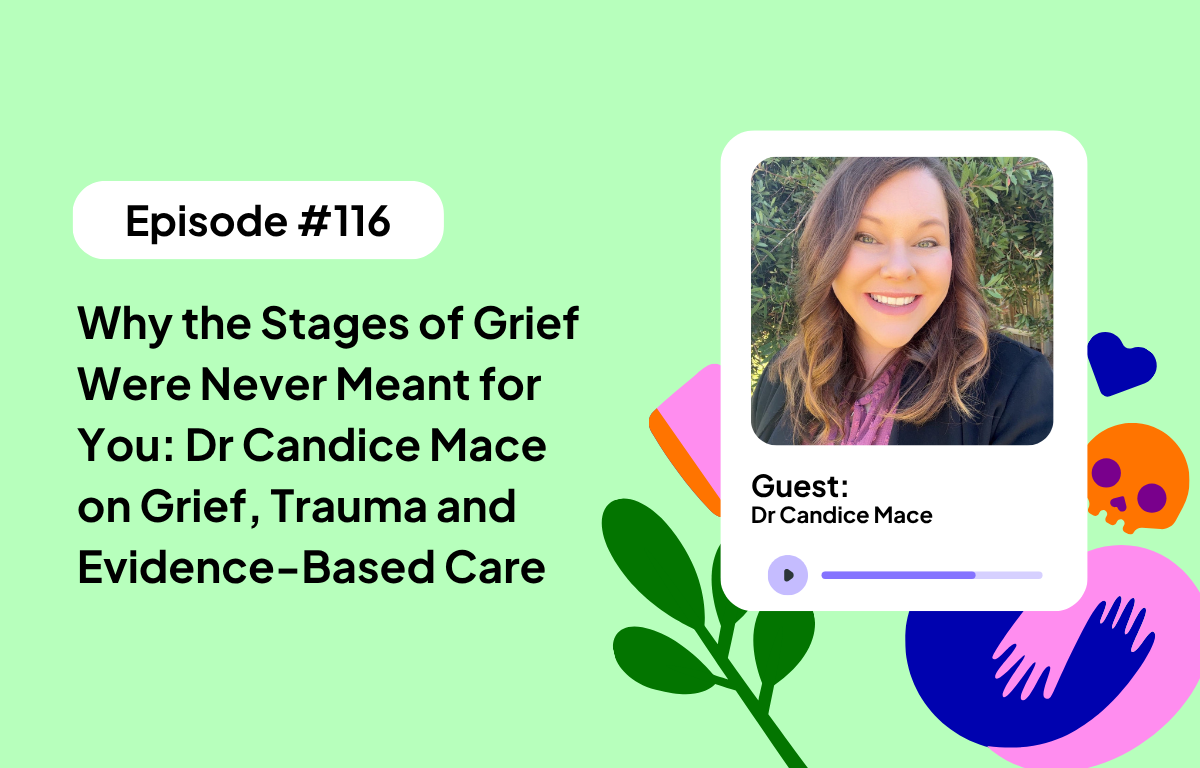
Meet Dr. Candice Mace
Catherine Ashton: Today I'm speaking with Dr. Candice Mace. [00:02:00] is a clinical psychologist, research supervisor, and sessional academic at Deakin University and the Cann Miller Institute, where she also completed her Doctorate of Psychology in Clinical. Candice's clinical and academic work
Catherine Ashton: centers on grief, loss, and trauma. Through her roles in private practice and community mental health, she specializes in complex and prolonged grief, trauma, and PTSD, integrating evidence-based research with a trauma-informed, person-centered approach grounded in lived experience. Candice's doctoral research, in collaboration with Dr. Russell Deaton, demonstrated the effectiveness of the Integrating Grief Program Victoria, a telephone-based grief counseling service delivered in partnership with Griefline. first study, published in Death Studies in twenty twenty-six, found that brief [00:03:00] telehealth grief counseling significantly reduced psychological distress among a hundred and ninety-seven people bereaved by sudden or traumatic death.
Catherine Ashton: Further research identified the client and the therapeutic factors associated with the greatest improvements, providing evidence to inform more targeted, accessible, and effective bereavement care. you so much for being with us, Candice
Candice Mace: Thank you so much for having me. It's great to be here
Journey Into Grief Research
Catherine Ashton: And tell me, what drew you into specifically focusing on grief and bereavement research as opposed to psychology more broadly?
Candice Mace: I think grief found me more than probably I found it, I think. I guess even before I was studying or even thinking about studying psychology, I was working in a completely different career for about ten years and, you know, during that time I experienced a pretty significant bereavement that, as it does for most [00:04:00] people, absolutely turns their world upside down.
Candice Mace: And as I slowly found my way through it, I realized that the work that I had been doing, it no longer felt as meaningful, as, say, advocating for or supporting people who are grieving. So that experience, I guess, ultimately led me into person-centered grief care, and really inspired me to retrain as a psychologist.
Candice Mace: So early on, in that, you know, transition into my new career, I worked as a bereavement counselor, for Griefline, supporting people after sudden and traumatic losses. and sitting with sort of hundreds of bereaved people challenged many of those assumptions that I had about grief. I learnt that every person's story was unique.
Candice Mace: I also started to notice patterns. There were some pretty common therapeutic processes that really seemed to help people adapt and integrate their loss, and other factors that appeared to, you know, maybe keep them feeling stuck. And when I looked to broader research, there was surprisingly little examining what is actually [00:05:00] happening within grief therapy itself that would really facilitate that change.
Candice Mace: So, as clinicians, I know we're all trained to support people through loss in some capacity, but I did become increasingly aware of just how common grief is, and at the same time, how under-recognized and perhaps under-researched it remains, particularly following those sort of sudden or traumatic deaths.
Candice Mace: And that curiosity became the foundation of my doctoral research. So rather than simply asking, you know, does grief counseling work, I really wanted to understand how it works. Who is seeking grief counseling? Who benefits most? Who might not? what are therapists actually doing in sessions? And what therapeutic processes seem to matter the most?
Candice Mace: And are different therapeutic pathways able to help different people? so I guess I'm understanding grief not just as a psychologist and researcher, but also someone who's lived through profound loss. And of course, that experience doesn't make me an expert in anybody else's grief, but it's certainly given me a [00:06:00] deep appreciation of how life-changing bereavement can be, and how important compassionate, evidence-based support really is.
Understanding Sudden & Traumatic Death
Catherine Ashton: And tell me, when you talk about, traumatic and sudden death, what sort of things are we talking about there for someone who may not be familiar?
Candice Mace: Yeah, sure. It really is, it's, it is subjective of course to an individual, but I guess literature would, would sort of maybe define it as anything that we're not expecting. You know, anything that's likely to really challenge our assumptive world. but even in my experiences, you may have some sort of assumption, say, with terminal illness, and it still end up being quite a sudden and traumatic experience for a person.
Candice Mace: I guess the differences is also how the grief response would look like for a person. Obviously, there's always a lot of emotion, depending on, you know, how attached we are to the person, the place, the thing, that we've [00:07:00] lost. but I think with traumatic losses particularly, or traumatic bereavements especially, there's often an element of shock.
Candice Mace: So that is likely to maybe extend our, I guess, what we would call the acute grief period of time, before we're able to then integrate it or adapt to it in some way. So usually with sudden or traumatic losses, we would see more of a shock, sort of particularly at the beginning. it may continue to come up, throughout the grief experience, and maybe more of an intense, level of feeling the emotion that's there, and maybe more of an intense disruption to the level of functioning as well.
Acute vs Adaptive Grief
Catherine Ashton: And there was two terms there that you mentioned, that was the, a sort of acute period and then a period sort of where we're integrating loss and the grief into our everyday life. Could you just sort of explain that for someone who's unfamiliar?
Candice Mace: Sure. So when we first [00:08:00] learn of that, loss, itself, I guess today, I am more thinking of bereavement, so, you know, when we specifically respond to the loss of a person or an animal. so when a person fir-first learns of that, we do go into this acute sort of phase, I guess, where we are feeling it more, we are more likely to be disrupted in terms of level of functioning.
Candice Mace: things like work or our home life, our relationships with people, can be really affected. we obviously feel a lot of the emotion at that point as well, where we're trying to plan things maybe like funerals. we're trying to do so many different things as well as holding all of this emotion.
Candice Mace: And we know grief affects us in so many different ways, you know, our biopsychosocial, spiritual, domains. So we're really feeling the grief. We're really finding it difficult to not [00:09:00] think of anything else really. But even in that, you may be aware of, I guess, the dual process model of grief, by, you know, two of my favorite people, Stroebe and Schut, where they sort of tell us that even in this period, we naturally swing between this loss-oriented space and this more restorative type space.
Candice Mace: So that's sort of happening in this acute period of time, and eventually what happens is the more that we learn to integrate both loss into our new way of being and thinking and feeling, we then have this more integrated or adaptive, way of grieving, where we still feel it, we still think about it, but maybe we are less, you know, intensely feeling it.
Candice Mace: Maybe we're starting to ask more questions about, "Well, what does this loss mean for me? Who am I? What am I doing?" So we're starting to think of more of those types of questions as we learn to slowly transition into that adaptive phase and out of the [00:10:00] acute phase.
The Ball in the Box Analogy
Catherine Ashton: When you're describing those two particular phases, what I'm thinking about is that classic sort of grief brain and the difficult that sometimes I know myself have experienced that intense time after someone has died and that difficulty of being able to function at, in a cognitive way as perhaps as clear as what I normally would. And then, you know, moving to that integration phase is when that kind of pain I feel for me personally hasn't been there as much and you learn to I don't know whether it's acceptance so much so, but for me personally it's just that you realize that they're not there but you can still recall them without as much pain as what I have been previously.
Catherine Ashton: Would that be sort of like a way to describe that from my personal experience?
Candice Mace: Yeah, absolutely. and, and what you've said really resonated [00:11:00] with me as well from my personal experience, I think, with grief. there's that analogy, you know, it's a great picture of, the ball in the box, and on one side you've got that big red grief button. And initially, you know, in that acu- acute phase, it's like the box seems to be quite small, or the ball is quite big, so it hits that button more frequently and more intensely.
Candice Mace: But over time, we start growing, and of course, naturally then the ball is missing that big red grief button. so maybe it's not hitting that as often. maybe it pings it on the corner so it doesn't hit it as hardly. Maybe sometimes it does hit it full on, and we do get that big grief reaction, but it's not every day or multiple times every day.
Candice Mace: and I think, you know, when it does hit that button, absolutely that cognitive fog that you speak of absolutely can be one of the ways that we respond with grief. But I think with me, and maybe what you're saying as well, is it sort of gets less and less, when we are [00:12:00] affected by... Someone called it recently psych ache, and I really love that term.
Candice Mace: We feel that psych ache when we grieve. so yeah, it really sounds like we're aligned, in that way with our personal experiences.
Debunking the Stages of Grief
Catherine Ashton: I'd like for you to just talk through that, myth around grief, if you wouldn't mind, about that there is the stages, because I think that that's something that would be great for people to just be reviewing
Candice Mace: Yeah, for sure. And I think Elisabeth Kübler-Ross, who coined that, coined the research and did a lot of great work with stages of grief, it tended to be, you know, quite an early way of thinking about grief. and she herself has said that it was never meant to be sort of relayed to bereavement as such of losing a person.
Candice Mace: It's more about the grief that we feel when we lose our health or when we have a terminal illness, and it's more about the person themselves who've been [00:13:00] diagnosed, what they go through until finally, you know, after they go through the shock and the denial and anger and bargaining and all the other sort of, experiences they have, finally maybe they get to some sort of acceptance that they've lost their health or maybe that they will die.
Candice Mace: so it was never intended, I think, to be generalized so much as it has been, into general literature or general grief. so more recent researchers have come up with quite a few newer frameworks to explain grief and grief theory. so I've spoken about one of them, the dual process model, which sort of says, well, you're in it or you're not in it.
Candice Mace: and naturally, we oscillate between both spaces, and then eventually we come together and learn how to integrate it. that's quite a common one. And then you've also got, I also like, William Worden's, tasks of mourning that, again, doesn't have to be in any sort of linear fashion. but it does give us a nicer framework of understanding what we [00:14:00] might experience with grief and in a way then sort of normalizes and validates, 'cause I do think the issue with, people taking the stages of grief is feeling like, oh, is my grief not real then because I didn't feel shock or anger, or I'm not at the acceptance stage?
Candice Mace: You know, we know grief is not this beautiful linear thing. It's more like this ugly em- emotional roller coaster that I can be shocked and angry at the same time, or I can be, yeah, accepting cognitively, but not emotionally. and so I think people start to doubt their experience when they do take that sort of framework as gospel.
Candice Mace: And I don't think any of the frameworks are meant to say, well, this is the way you should do grief. but some people may find them helpful, to learn that there are other sort of, theoretical frameworks that can apply to their grief, not just the stages of grief.
Why Grief Research is Limited
Catherine Ashton: And you mentioned, in the opening how there was very little research, in relation to grief. Why do you think that [00:15:00] is, Candice?
Candice Mace: I guess anecdotally from my experiences, grief in general make people-- can make people, pretty uncomfortable, and I think that includes clinicians, therapists, researchers as well. it does... You know, I've even heard some therapists say to me, you know, "I don't like working with grief because I can't fix it."
Candice Mace: And yeah, that's not our job. Our job is never to fix this sort of experience. It's to, just to really help and support as you naturally will go through it yourselves. so maybe that could be why. I also think a lot of, thinking with my clinical psychology hat here that, do we, do we want to pathologize something like grief?
Candice Mace: And if we can't pathologize it, is it worth researching? Maybe that could also be, a general opinion that might be out there. it's, it's certainly an interesting one. I'm loving seeing so much new research come, and there's been so much great in the past as well, [00:16:00] but just not a lot of it, unfortunately.
Candice Mace: I have seen, generally speaking, since, there was the introduction of the prolonged grief disorder in our diagnostic manual, the DSM, version five text revise back in two thousand and twenty-two, that there has now been an influx of, research around that particular disorder. So it's interesting once it has been pathologized in a way that there's a label that there's now a lot of research sort of coming to light with that.
Candice Mace: but yeah, just a few, a few thoughts as to why it may not be that popular to research.
Catherine Ashton: Prior to it being, as listed as a diagnosis in that manual, w-
Diagnosing Grief: DSM vs ICD
Catherine Ashton: was it actually a diagnosis that you could provide?
Candice Mace: Well, not s-- depends again on what diagnostic manual people were choosing. There is another one, called the ICD, the, International [00:17:00] Classification of Diseases, version 11, I think they're up to now, which is more popular in hospitals and that sort of setting, and also internationally. that tended to have more of a, a diagnostic thing for grief much earlier.
Candice Mace: They were calling it complex grief. but in Australia, we're using the DSM, and it was only sort of recognized, as a disorder, in two thousand and twenty-two. prior to that, it probably would fall under some sort of adjustment disorder or, depressive disorder, or even anxiety disorder, or stress disorder if there were sort of traumatic elements to it.
Candice Mace: but again, I think it depends on the individual that you're talking to, what a label means to them. It's really, for a lot of people, grief is not something that needs to be pathologized. But for some people, they would find it really validating to go, "Oh, well, yeah, these experiences that I'm having, there's actually a name for this, and there's, there's maybe this label for it as well.
Candice Mace: And that really [00:18:00] is validating for me to hear that it's recognized in that way." but, you know, it's important for me as a clinician to discuss that with my clients, to even know, is this something that matters to you? If not, let's talk about the symptoms. Let's talk about what you're presenting with and how I can help in that way.
Catherine Ashton: It's interesting that you say that because when I think of grief, it generally is always how I've experienced it, has been associated with another feeling, whether it be, you know, anxiety or adjustment, you know, of some sort that I'm having to make. So I can see why it, is quite difficult to actually sort of separate it out as its own, you know, thing to diagnose
Candice Mace: Yeah. 'Cause as you know, grief, we just respond to it so differently as individuals, and I think that's why, you know, a big part of my research is interested in understanding, well, how do individuals respond to this? Because [00:19:00] then we can look at, well, what treatment is then effective for that individual if they're responding with this type of grief.
Candice Mace: Because I think context is so important. you know, how we were related to the person is so important as well. I guess that attachment that we feel, who we are as people, what coping strategies we have. it's so, it's so individual, our grief response because the individual relationship we have with the person that we lost, well, that's also, an individual thing as well.
Candice Mace: Like take siblings, for example, that may lose a parent. They come biologically from the same environment... Oh, sorry, biologically, from the same genetics, and they grew up in the same environment, so wouldn't their grief be the same? Well, no, because they are different people who have different relationships with their parents.
Candice Mace: So yeah, we really do need to be looking at the individual and their individual response to that.
The Integrating Grief Program Victoria
Catherine Ashton: And I think this [00:20:00] is a really good time for, if you wouldn't mind explaining exactly what the Integrating Grief program, in Victoria was, how that started,
Candice Mace: Yeah
Catherine Ashton: it started, and then moving into what you found
Candice Mace: Yeah, sure. So, the Integrating Grief Program of Victoria, I might just say IGPV for short. it's, it started, I think back in two thousand and nine. Don't quote me on that one too much, but it's been around for some time. and it's a partnership between, Victoria Police and an organization called Grief Line, and it was funded by the Southeastern Melbourne, Primary Health Network.
Candice Mace: So what it is if a member of the community, if they experience a police-attended death, well then Victoria Police can, with a person's consent, refer them to Grief Line, and Grief Line will then provide up to six sessions of specialist grief counseling. And one of the things I really like about the program, and it's quite unique in that it [00:21:00] reaches people very early, often before they've even thought about seeking support themselves.
Candice Mace: So it is designed to be an early intervention service, recognizing of course that the period immediately following a sudden or unexpected death can be incredibly overwhelming. people, as we've spoken about, they're often trying to cope not only with emotional impacts of their loss, but also with practical realities that come after a death, all while usually experiencing shock and profound grief.
Candice Mace: So the people that we tend to see referred to a program like IGPV, they've often experienced incredibly sudden losses, such as, more natural deaths like heart attacks or strokes. but then there's also things like accidents or drownings or, you know, overdoses, other sort of unexpected deaths.
Candice Mace: it could also include situations, though, where a person may have had diagnosed illness, but the death itself was still sudden or unexpected, such like with cancer or, even chronic obstructive pulmonary [00:22:00] disease, which again could lead to more intense grief responses. these members of the community that are referred, many of them have witnessed the death themselves or have been the person who discovered the deceased person.
Candice Mace: there are people that, wouldn't be, I guess, suitable for the program, because there are specialist services that exist. So if the death was a homicide or suicide, or it was a motor vehicle accident or an infant death, well then they would be referred out to other sort of Victorian specialist services like the TAC or Red Nose.
Candice Mace: So that's, yeah, a little bit about IGPV.
Catherine Ashton: And then with that service, obviously it's been going for a period of time. What m- what,
Research Methodology & Findings
Catherine Ashton: how did it come about that you did your research in that?
Candice Mace: So we recognized, that it was an amazing service that had been around for some time, therefore selfishly thinking quite a lot of data that would exist already. and so that's sort of where we started, where we were analyzing, I guess, what we call retrospective data. We [00:23:00] were looking at the data that already existed and trying to look at some sort of trends and effectiveness that existed.
Candice Mace: From that, we then, were looking at, well, okay, we can see that the program itself is actually effective, but we couldn't get quite a lot of specific detail that we needed. So we then created, I guess phase two of it, which was looking at collecting more data, of course, with, a lot of ethical considerations and consent from participants as well.
Candice Mace: So we were able to then collect a lot more data in terms of the measurements that they were using. so looking at, of course, quantifiable data. but then we were looking at, more so what was happening within the session that would then lead to these sort of, results that we were seeing. So we created a novel questionnaire, that talked about things like, well, what were you talking about?
Candice Mace: And what emotions were expressed from the participant? what interventions were you using? [00:24:00] and, what sort of coping processes were spoken about? So it would be pretty time-consuming and of course, very unethical to data mine things like case notes, so we created this questionnaire so the counselors could easily tick off, yep, we spoke about this today, and, you know, the client expressed anger or sadness, and yes, they cried.
Candice Mace: and I used a bit of psychoeducation or values-driven work, and we spoke about self-care. So we just tick, tick, tick, tick. and so we were gathering all of that information, so we could then compare that to some of the measurements to hopefully identify what was causing that change that we could see.
Catherine Ashton: and what were the things that you were finding?
Candice Mace: Yeah, great question. So, with, I guess study one, what we were seeing. So study one was retrospective. we were more interested in the questioning, you know, at that point, does it work? And yes, we did find after six sessions of the counseling, participants did [00:25:00] experience significant reductions in psychological distress.
Candice Mace: We found that almost half of them showed reliable improvement, and around one-third was demonstrating both reliable and clinically significant change. So provided really strong evidence that, the brief telephone-delivered grief counseling through IGPV can effectively reduce distress following police-attended bereavement.
Candice Mace: So then in, studies two and three, which was phase two, we asked, well, who's benefiting most? What factors influence outcomes? This is where we found grief isn't the one-size-fits-all, okay? So things like a person's relationship to the, to the deceased, the cause of death, the level of social support they had, the age of the participant, their cultural background, and what their initial risk, well, that was all influencing how people were responding to counseling.
Candice Mace: Specifically, what was happening in session, we found that the approaches [00:26:00] like psychoeducation, experiential exercises, and reviewing what was happening for them more recently, so their recent experiences, that was associated with greater improvements We then looked a bit further. So in our third study, we explored, well, how that grief counseling is gonna be facilitating change by examining what happened from one session to the next.
Candice Mace: So we found that by helping clients reframe their unhelpful thoughts, by developing adaptive coping strategies, by reconnecting to everyday life, by engaging in meaning-focused conversations, consolidating self-care, and experiencing emotional relief, well, that is all predicting lower psychological distress at the following session.
Candice Mace: So we were able to prove, you know, it's not just from start to finish. We were looking at session by session as well to see, well, what did I do in this session? Did that affect what happened in subsequent sessions? And yes, we [00:27:00] did find some really beautiful results there as well. So overall, I think the three studies, are telling that really important story.
Candice Mace: We know brief telehealth grief counseling through a program like IGPV is effective, but it's not equally effective for everybody. the impact is gonna depend on who the person is, circumstances of their loss, and the therapeutic processes that we used in counseling. So rather than taking that one-size-fits-all approach, I really think grief care should be tailored to that individual and focused on psychological processes that help people adapt to life after their loss.
Age, Attachment & Grief Outcomes
Catherine Ashton: And what were the, some of the age groups that were responding the best to the telehealth support? S- what were the ones that weren't responding? Like, what were some of the variables that were clear trends that you were seeing in the data?
Candice Mace: Sure. So we did, so for our parti-participants, we had a beautiful, [00:28:00] varied, you know, sort of, range of ages. So we were able to measure from age eighteen all the way to age eighty-five. So we had quite a nice spread there. So we did find that age, had significant main effects and also interactions over time.
Candice Mace: So that, indicated differences in both overall distress levels and that trajectory of improvement across treatment. With younger participants, we did find that maybe-- not maybe, they did have, the highest levels of distress, and they also showed the greatest variability over the course of the six sessions.
Candice Mace: as we start to get a little bit older, so, ages sort of twenty-one to sixty-five, they were demonstrating more consistent reductions in distress. While older adults, so over sixty-five, they were generally reporting the lowest distress throughout treatment. they did show a slight increase, sort of halfway through the program, and that improved again, so that dropped again [00:29:00] by the final session.
Candice Mace: So what I was thinking with that, I guess, to explain those sort of trends that we saw between younger and older adults is that, bereavements experienced during younger or young adulthood, it's often occurring alongside their major developmental milestones. So at that age, most people were establishing careers, establishing relationships, and a sense of who we are, so our sense of identity.
Candice Mace: And the loss of that important person at that time can really disrupt those processes, particularly while our coping resources are still developing. if we contrast that in older adults, well, they may draw on greater life experiences. They may have had more practice at regulating emotions. they may have also experienced previous losses, all of which I think could help them adapt more effectively, during those earlier stages of grief, where they would be having something like the IGP-V [00:30:00] program.
Catherine Ashton: And that totally makes sense that the more exposure and experience we have, that sometimes the better we are with coping with that. and what were some of the other things when you talk about who- our important person that has died, that relationship, what impact did that have?
Candice Mace: Yeah. So the relationship to the deceased was one of the factors that we looked at. So we were sort of categorizing them into, things like, you know, if it was a child that they lost or if it was the parent, the sibling, a spouse, or other relationship. from memory, in the other relationship category, it would be things like roommates, neighbors, other distant family members, second cousins, that sort of thing.
Candice Mace: so what we found there is, participants that lost a child, they were the ones that consistently reported the highest levels of psychological distress across all six sessions, [00:31:00] and they reduced relatively little over time. So what we can say there is people that lost a child consistently highly distressed across all six sessions.
Candice Mace: in contrast, those that lost a parent or a sibling or a spouse, well, they showed similar patterns of moderate distress, and they gradually improved by the six sessions. And participants bereaved of more distant relationships, well, they would report the lowest and most stable levels of distress. So what comes to mind to me for that one is, of course, attachment theory, and also broader bereavement literature, which does suggest that emotional closeness and attachment, and I guess how significant that attachment is to us, may influence both how intense the grief is and also how they're likely to respond to brief counseling interventions.
Candice Mace: So if we think about the loss of a child, that's may involve greater identity [00:32:00] disruption, shattering of assumptions, loss of anticipated futures, making that distress more persistent and less responsive to brief counseling. And I guess what I mean by assumptions and loss of anticipated future is maybe a lot of us when we have a child, we assume that we will die before the child.
Candice Mace: maybe we will see them grow up, get a job, go to university, have a family, go to their wedding, be grandparents, whatever, you know. That's what we're sort of anticipating and assuming is gonna be happening in the future. So if that doesn't happen, I think that's when we see distress more persistent, less responsive.
Candice Mace: Opposite to that, I think the more distant the loss is or the... maybe the, the weaker the attachment perhaps, I think that's gonna involve fewer disruptions to everyday roles and future expectations. That's going to lead to, of course, lower, more stable [00:33:00] distress. so the important thing I think to remember there is while brief grief counseling can provide that important support and stabilization, it may not be sufficient to fully address profound attachment disruptions that we do see with the loss of a child or other highly significant attachment figures.
Candice Mace: So those sort of people may benefit from longer term or more specialized bereavement interventions.
Catherine Ashton: When you're thinking about counseling and just what those different methods are, depending on what particular, sort of attachment that particular person might have to the people- person who's died,
When & How to Seek Support
Catherine Ashton: is there a recommendation or suggestions about what sort of help someone should seek depending what situation they are?
Catherine Ashton: I know you said that it's quite unique on each person, but is there some assumptions that we can make based on the research that you've s- done?
Candice Mace: In terms of what type of counseling works well?
Catherine Ashton: And what sort of support and how early the [00:34:00] support comes in
Candice Mace: Yeah, sure. again, as you said, it is individual. So broadly or generally speaking, I guess my mind is going, "Where do I go first?" 'Cause,
Catherine Ashton: I know,
Candice Mace: I know
Catherine Ashton: and I,
Candice Mace: yeah, I'm thinking.
Catherine Ashton: haven't I? would you like
Candice Mace: that's fine
Catherine Ashton: it, rephrase it in some way? so maybe I might
Candice Mace: No
Catherine Ashton: just like it's a, not a one-size-fits-all approach, but, you know, for someone... Okay, I'll rephrase it, this one cleanly for you. with the research that you've conducted, and bearing in mind that the- we understand that there's not a one-size-fits-all approach, is there any trends or anything that you've seen when... would suggest that someone when they're seeking support, when they should be se- seeking it? Is earlier better? what type of support they should be seeking
Candice Mace: Yeah. it's tricky because it is, Yeah, we do really need to meet the [00:35:00] person where they're at, and that can be the delicate dance as well, because we could see that you need help, because maybe it's affecting, even how you're looking after yourself or if there's other people that are dependent on you.
Candice Mace: But just like any sort of mental health, sort of issue that people might be struggling with, we need to get that person on board. So we do have to be a bit delicate about, you know, suggesting when is the best time. But I would definitely say if we do see a person that is, you know, maybe not having quality social supports, and what I mean by that is we can be surrounded by people all wanting to help, but it may not be what that person necessarily needs.
Candice Mace: I think what can happen there is that, you know, people may feel misunderstood or not receive the kind of support that they're actually needing. and well-intentioned people may try to sort of fix grief, but that might encourage them to move on too quickly, [00:36:00] which unintentionally invalidates their experience, so that can actually do the opposite to what we need.
Candice Mace: so I think As soon as you notice people are struggling, asking them, "What is it that you feel that you need?" I like to do the whole, what can we do to make things one percent different? Because if you were to ask a grieving person, "Hey, what do you need?" They're probably likely to tell you, "I don't know."
Candice Mace: so going in with practical stuff is also, a really good thing to be doing for those sort of people. Getting groceries, cooking, cleaning, laundry, looking after kids, that sort of stuff. I think with those sort of people that may be not getting that quality level of support, that's where I would be, you know, gently suggesting maybe professional support is a good, a good thing for you to be, leaning on.
Candice Mace: So whether that is even your GP, psychologist, a, a community counseling service like Grief Line, any other sort of services that you may feel would be helpful, that's when I [00:37:00] would sort of be suggesting that. So if we're noticing that their level of social support is lacking, their functioning is affected, that is the time where I would be gently suggesting that we probably need some intervention, to help them.
Candice Mace: When that is, though, that's a, it's a really tricky, tricky thing to know when is the best time, to actually see those sort of, yeah, to see those sort of effects. It might be early on, it might not be till months down the track. So I think, yeah, if we're lucky enough to have those sort of people to look out for us, or to educate a person, "Hey, this is what you might experience," that's when we need to look out for it.
Candice Mace: But we definitely do find, the early intervention stuff, particularly through my study, was working better for people who, did feel, you know, that they had at least a medium level of social support, and that they were open, to those sort of suggestions. the people that were really struggling were the people like, you know, either had experienced a highly traumatizing event, or the relationship loss was [00:38:00] incredibly traumatizing for them.
Candice Mace: So they were probably sort of needing more longer term to support for their grief. I hope that sort of answers in a very rambling sort of way what you're asking.
Catherine Ashton: it totally does. Do not worry. that was... And it was not rambling whatsoever. and I like the practical s- ideas that you give people about the fact that you can support people by walking the dog or, you know, taking the kids, doing the grocery shopping, those sorts of things. Because, y- you know, you're right in saying that, you know, I recall from the times that I've experienced it, is that sometimes people don't know what they want, so it's hard to provide an answer to someone when they ask, "What do you want?" But I do like your question about your 1%. think that's
Candice Mace: Yeah
Catherine Ashton: a good way to phrase it too
Candice Mace: Yeah. and I certainly have been on the receiving end of feeling [00:39:00] overwhelmed at times. and your answer is, "I don't know, I just don't want to feel like this," you know? It's like, "Well, have you had a shower today? Have you brushed your teeth today? Have you had a cup of tea today?" You know, those are all things that maybe we could just feel just 1% different.
Candice Mace: so those sort of suggestions, you know, starting with the very basics, can be really helpful if a person is feeling very overwhelmed with their grief
Catherine Ashton: And when you were, thinking about your clinical work, what
Candice Mace: Mm-hmm.
Catherine Ashton: Y- you've mentioned prolonged grief.
Prolonged vs Adaptive Grief
Catherine Ashton: what does that look like compared to just normal grief?
Candice Mace: Yeah. it's, it's interesting that word normal, isn't it? and I'm so
Catherine Ashton: and it's totally the wrong probably term to use. Sorry, but
Candice Mace: No, not at all. No, not at all. It's just my ears, like, prick up straight away because everyone's gonna go, "Well, what's normal?" You know? I probably would use something, more like adaptive grief, so... Or even ordinary grief, I [00:40:00] think a few people would go, "Well, what is that?" So maybe, like, adaptive grief is something that, yes, as we spoke about, is, maybe incredibly, you know, upsetting or makes us dysfunctional for a shorter sort of acute period of time, but then we're likely to adapt to it, you know, in a reasonable timeframe, I would say.
Candice Mace: we know there's nothing, I guess, ordinary about losing somebody that you love. I think that adaptive grief, or normative grief, it doesn't disappear, but we do begin to reengage with life. We do begin to experience moments of joy again, and we do learn how to carry that loss alongside our living.
Candice Mace: With something that, we would call prolonged or complex grief, this is where people can begin to feel that they're unable to move forward because that loss continues to dominate almost every aspect of their life. commonly, we would [00:41:00] see things like intense yearning for that loved person. people have described feeling like a part of themselves has died, struggling to accept the reality of the death.
Candice Mace: They may avoid reminders of the person or the death. they may feel that life, no longer has meaning for them. And that grief, that type of grief remains so overwhelming, it really significantly interferes with their relationships, their work, their daily functioning. When we see a significant interference with multiple domains past that 12-month mark, and their grief is so overwhelming to them, that's when they could meet that criteria for that prolonged grief disorder that I mentioned before, which was introduced into our latest edition of the DSM, our diagnostic manual back in 2022.
Candice Mace: there is evidence that suggests people with traumatic bereavements or those who have lost a partner or a child are more susceptible to developing something like prolonged [00:42:00] grief disorder. I think with that, the important thing to remember is that grief itself isn't a disorder. It's a really normal response to losing somebody that we love and care about.
Candice Mace: It's when that grief remains so intense and persistent that it prevents you, from adapting to life after loss that we start to think about whether maybe, more specialized support might be helpful.
Candice's Personal Grief Journey
Catherine Ashton: I like the idea when you were saying that they're people engaging back with life, you know? and that's a good thing. With your own personal experience, when you look back in retrospect now with everything that you've learnt, what is it that you have learnt from what you, what your o- own experience was to where you are now about grief and how to cope?
Candice Mace: Yeah. [00:43:00] Great question, and I've done so much reflection on this over the years. I will basically say don't do what I did because I joke that I'm half German, I'm half English, so I'm stoic with a stiff upper lip. That's... I had to unlearn all of that, to basically do the job that I do, but to process my own grief.
Candice Mace: so in my experience, I lost my sister in a very traumatic way, and I went back to work the next day because that's what you did, and I just kept compartmentalizing it, avoiding it, keeping myself unnecessarily in shock and denial for a lot longer than probably what my body was trying to tell me.
Candice Mace: And eventually, I started to have some of the somatic symptoms that we see in sort of medium to long-term stress and went to my GP to say, "Hey, I need some sort of medication for this. I'm not sleeping. I'm not doing well. I'm not functioning." And they gently suggested that I needed to see a counselor or a [00:44:00] psychologist, and I remember going, "No, but nothing's wrong with me.
Candice Mace: I'm just, my body is failing me." And they gently persisted, and so I did. So obviously, through that experience, I learned so much about self-care, emotional self-care, psychological self-care, what was normal, what was permissible, what was expected of me in that time, which is really just gentleness and compassion, and really having to unlearn a lot of that.
Candice Mace: You know, that process took some time, and so now, when I've since experienced grief, you know, losing my elderly dogs or losing my grandparent, just treating myself in a very different way. and so my biggest piece of advice, I think, for myself and maybe anybody else that's listening, is that let it be intuitive.
Candice Mace: The body and the brain are very smart. They're very automatic. If we trust in that process and we listen to them when it says, "Ah, maybe you need to cry [00:45:00] to release some of that emotion and to regulate some of that emotion. Maybe you need to sleep or eat, or maybe you need to have a cuddle," whatever it might be- Do it, you know, because that's an intuitive part of it, isn't it?
Candice Mace: we obviously want to be mindful of risky sort of behaviors. There are things that the brain will try to tell us is a great idea, but we know that that's not very helpful over time. You know, things like drinking a bit more alcohol, or eating different foods, or doing other sort of riskier type behaviors.
Candice Mace: they may feel helpful in the moment, but we know that they're not that helpful longer term. So don't confuse intuition with grief to those sort of, stories that the mind makes up, if that makes sense. but I do think just giving it the attention that it deserves. I know that you've interviewed my good friend, and colleague Brian Pethering before, who introduced me to this concept of if we do lock grief away, and grief is one of those emotions that if we do try to compartmentalize it, [00:46:00] think of it like locking it down in a basement.
Candice Mace: It doesn't stay there. It actually pumps weights and gets stronger the longer that you keep it down there. So eventually, that bugger is gonna burst out, okay? So it's actually better to learn how to tolerate the discomfort, because grief is incredibly uncomfortable. It challenges us like nothing else, I think.
Candice Mace: And if we can say, "Okay, well, I don't like you, but I'm gonna invite you to sit at my table and have dinner with me, grief. I'm gonna learn how to tolerate you." And that's the other thing that we can do as well to sit with the grief. We're not locking it away. We're learning how to integrate it, because it isn't gonna go away, and it isn't something we can necessarily fix overnight.
Candice Mace: What we can do is learn how to grow around it, and I think that learning to tolerate it is a big part of growing around it. So I think for my personal reflections, [00:47:00] do get some professional support if it is affecting you know, in a way that's significantly, dysfunctional, like whether it's self-care, or work, or relationships, or whatever it might be.
Candice Mace: Do lean on those sort of supports if you need to. Looking after yourself, taking it back to basics, you know, good sleep, good nutrition, movement, sun, social interactions, all the basic self-care stuff that we need. I think as well being open to, you know, I'm, I'm now 13 years down the track, right? since losing my sister, and my grief does look different.
Candice Mace: Sometimes as we spoke about before, it catches us by surprise, and I'm griefy all of a sudden. So instead of locking that away, I acknowledge it, I sit, I might cry, but I also look at how grief has changed for me. And recently, more recently, it has delved more into the spirituality side of things. So being open to looking at how grief can be so dynamic as you keep going through your adaptive life with [00:48:00] it.
Candice Mace: just holding it in a way that feels intuitive, that's, that's worked really well for me
Where to Find Support
Catherine Ashton: Thank you for sharing that, Candice. and I like the fact that you have spoken about grief as being a physical thing that you can feel, and going to your GP and saying, "My body's not working," to
Candice Mace: Yeah.
Catherine Ashton: then talk,
Candice Mace: Fix it.
Catherine Ashton: to then talk about how in reflection now, 13 years down the track, it's, it's now something spiritual for you. where do you... You have mentioned it briefly before, but I think it's good just as a prompt, to remind people if they do need support, where d- where do they go? You've mentioned the GP
Candice Mace: Yeah. So again, depends on what they need support with. But, you know, for a lot of people, they may have informal supports like family, friends, their community, whether that might be a church or some other, community group that they're in, a sports team, something like that. So that's what [00:49:00] we'd sort of call more informal supports.
Candice Mace: and then you have- may have more of your professional formal supports like, healthcare providers, like a GP, a doctor, psychiatrist, allied health, like your counselors, your psychologist, your therapists, art therapists, music therapists, play therapists, whatever it might be. and of course, then there's more sort of, community-type supports as well, like, community, What comes to mind? Grief Line, of course. Grief Line, Lifeline, Beyond Blue. There are also specific grief organizations that exist as well, depending on what your specific circumstance is. So, you know, if you've lost a child or a sibling, there's things like the Compassionate Friends, there's Support After Suicide, if you've been impacted by someone that you've lost to suicide.
Candice Mace: there's just, yeah, there's so many more, that may exist in your specific areas as well, where you live.
Impact of Cause of Death on Grief
Catherine Ashton: So Candice, was there anything in your research about the type of death, whether that had an impact [00:50:00] on how someone grieved?
Candice Mace: Yes. Uh, I found this one actually incredibly interesting. So in terms of cause of death, um, we, with our... So this is, uh, information that we, we gathered in, in study two. Um, we found that participants that were bereaved, uh, through losing a person to cancer or drug overdose, well, they actually reported the highest level of psychological distress when they first entered counseling.
Candice Mace: Um, what we found is, while distress following a drug overdose, it gradually reduced across the six sessions. Uh, the people that were bereaved through, uh, losing someone to cancer, they tended to remain comparatively more distressed all the way till the final session. So the opposite to that, in contrast, participants bereaved through progressive illnesses, um, or even other sudden accidental type [00:51:00] deaths, they reported a lower level of psychological distress overall, and they showed the most consistent improvement throughout counseling.
Candice Mace: So it does tend to j-s- words. It does tend to suggest that circumstances surrounding the death, um, absolutely shapes the bereavement experience in meaningful ways. What we think was happening, um, with those results is that cancer and overdose deaths, they often involve, um, particularly complex experiences.
Candice Mace: So cancer, for example, can involve months or even years of caregiving, uh, can involve things like anticipatory grief, um, emotional exhaustion or fatigue, significant changes to family roles, and that all happens, you know, before the death even occurs. So when a person actually dies, then many bereaved people, they're not only grieving the loss itself, but they're also adjusting to an end of a really intense caregiving journey and of course, the identity [00:52:00] changes that come with it.
Candice Mace: Um, similarly, I think, uh, bereavements that follow a drug overdose, well, they can involve additional challenges such as stigma when it comes to taking drugs, guilt, maybe I didn't do enough, um, a lot of unanswered questions, maybe people didn't even know they were taking drugs, um, and potentially some pretty complicated family dynamics along with it.
Candice Mace: So while counseling did appear to help reduce that distress over time, people often arrive with very high levels of emotional bur-burden. So again, broader message here, grief isn't one size fits all. The context of death matters, um, and understanding those differences can really help us provide more tailored, compassionate care, rather than assuming that the same therapeutic approach is always gonna meet everybody's needs equally well.
Thank You & Goodbye
Catherine Ashton: Yes, thank you so much for sharing insights into the research that you've done, uh, [00:53:00] but also about grief, uh, in a more detailed manner as well and, and where we can get support. Thank you so much for your time
Candice Mace: My absolute pleasure.
Outro