

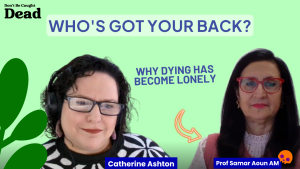
Who's Got Your Back?
This week's Don't Be Caught Dead podcast pondering!
Catherine Ashton
Jul 12, 2026
I didn’t ask a guest this question — it’s one a guest asked me!
“Who’s got your back?”
That’s Professor Samar Aoun, one of Australia’s leading voices in grief and palliative care, and it’s the question she poses to every community she works with. Not “who will you call when you’re diagnosed.” Not “who’s your emergency contact.” Who’s got your back — as in, right now, today, before anything has gone wrong at all.
I want to sit with that question for a bit, because the more conversations I have on this show, the more I think it might be the most important one we can ask each other.
Do we actually need more hospitals?
Samar’s research found that 90% of people cope with grief through the support of family, friends and community, and only 10% ever need professional intervention.
Ninety percent. Not a psychologist. Not a grief counsellor. Just… people. Neighbours. The person from the cycling club. The mate who shows up with a lasagne and doesn’t ask you to talk about it if you don’t want to.
So why does it feel like we’ve built an entire system around the 10%, and left the 90% to figure it out alone?
Samar told me that grief had become so pathologised and medicalised that it became unsustainable. Services were expected to help everyone who experienced a death, even though grief was never meant to be something we diagnose or fix. For most people, it isn’t an illness, it’s a profoundly human experience. What we lost wasn’t our ability to grieve. We lost our confidence to support one another. Grief didn’t need another service. It needed us.
Which makes me wonder: when was the last time you showed up for someone who was grieving, not because you had the right words, but because you were simply there?
Are we ready for what’s coming?
“It’s like a tsunami of death that’s going to face our systems, and they are not ready for it.”
The baby boomers, she explained, will all die within the next twenty years or so. It’s a demographic wave nobody built the system for, because we’ve simply never had this many people ageing, at this scale, at the same time.
I asked researcher Greg Sutherland about this from a completely different angle, he studies brains, not communities, and he landed in almost the same place. He told me the ageing population is set to double in the coming years, and that dementia has now overtaken heart disease as Australia’s number one cause of death. Two experts, two totally different fields, both waving the same flag.
So here’s my question for you: if 60% of us are dying in hospitals right now, and we don’t have the beds or the workforce for double that number, where exactly do we think this is all going to happen instead?
Samar’s answer is blunt: home. Community. Us. But only if we actually get ready.
Is it death we’re scared of — or dying?
“People are not scared of death. They’re scared of dying — because dying carries with it that taboo, the stigma, the social isolation, the anxiety, the depression.”
I’ve heard versions of this from almost every guest I’ve sat down with. Psychologist John Malouff put it slightly differently to Samar, he told me a little fear of dying is healthy, even adaptive, it’s what makes us look both ways before crossing the road. But too much of it, and you miss your whole life trying to outrun something you were never going to outrun anyway.
And then there’s Annie Raser-Rowland, who sat with her father as he died at home, surrounded by open windows and birdsong, and told me that it wasn’t the death itself that hurt the most. It was everything that came after. The ongoing, quiet absence of him.
So maybe the question isn’t “are you afraid of dying.” Maybe it’s: are you afraid of the isolation that so often comes with it? Because that part, at least, is something we can actually do something about.
Who’s actually in your corner?
Samar told me about a man named Tony, diagnosed with brain cancer, who came home to Albany to spend his last weeks near the ocean, four hours south of Perth. Tony belonged to a cycling club. One woman in that club looked around and said, essentially: right, let’s organise this. Who can do the grocery run. Who can fix a bike. Who can sit with Tony so his wife Heather can get to the gym, or just have a coffee with a friend by herself.
A roster. From a cycling club. That’s it. That’s the whole intervention.
“Tony was never by himself,” Samar said.
This wasn’t a program. Nobody designed it. It just happened, because someone asked the right question at the right time. Samar’s team has built the formal version of this — the Compassionate Connector program — and found it didn’t just make people feel less alone. It reduced hospital admissions. Reduced emergency department visits. Because when you’ve got someone to call on a Sunday when the anxiety creeps in, you don’t need to admit yourself to hospital just to have someone to talk to.
I heard an echo of this from Barry Du Bois too. His mum, he told me, started a cancer support network in her own town, organising things as simple as hospital transport, so the primary carer could finally get a break. No funding round. No committee. Just someone who noticed a gap and filled it.
And carer and researcher Linda Rowley reminded me that even the most loving friends and family can struggle to really get it if they haven’t lived it themselves, which is exactly why carer-specific networks matter so much, alongside the informal ones.
So, who’s on your list?
If you got sick tomorrow, who would know to bring the groceries, who’d sit with you, who’d give the person doing the heavy lifting a break?
If you can’t answer that easily, you’re not alone. Most of us can’t. But Samar’s point is that this isn’t a list you build in a crisis, it’s one you build now, while you have the time and the capacity to invest in the people around you.
The question I keep coming back to
Samar said something to me that I think about often: that it’s not about paying taxes to a government and expecting to be looked after from cradle to grave. You can’t buy love. You can’t buy friendship. The care that actually holds us together, in the end, is the kind we build with each other, long before we ever need it.
So — who’s got your back?
And just as importantly: whose back have you got?
If you’d like to listen to this episode of the Don’t Be Caught Dead podcast or any other, you can do so via this link.
You may not be ready to die, but at least you can be prepared.
All the best,
Catherine