Theresa: [00:00:00] not offered any meaningful support around the terminality of it. Again, because dementia
is collapsed
into the end stage. Everybody thinks about the pointy end of dementia. That last two years, and there is no doubt that the last two years happens.
I'm not trying to argue it doesn't. But what about the years before the end? Nobody's looking there. And that's where I'm at.
PENNY: Welcome to Don't Be Caught Dead, a podcast encouraging open conversations about dying and the death of a loved one. I'm your host, Catherine Ashton, founder of Critical Info, and I'm helping to bring your stories of death back to life because while you may not be ready to die, at least you can be prepared.
Don't be caught dead. Acknowledges the lands of the Kulin nations and [00:01:00] recognizes their connection to land, sea, and community. We pay our respects to their elders past, present, and emerging, and extend that respect to all Aboriginal and Torres Strait Islander and First Nation peoples around the globe.
Catherine: Today I'm speaking with Theresa Flavin. Theresa is a human rights advocate and lived experience leader in dementia policy, research and care. She was diagnosed with younger onset Alzheimer's disease in her mid forties, and since then, has become a powerful voice for the equitable inclusion of people living with dementia in decision-making at every single level from everyday care to national and global policy.
Theresa, thank you so much for being with us today.
Theresa: It's my pleasure, Catherine. Thank you for asking me.
Catherine: So Theresa, I had the beauty of meeting you at the Advanced Care Planning International Conference last [00:02:00] year in October. And before I met you, I was hearing lots of people speak about the amazing speech that you had done as part of the opening of that particular conference.
So you were diagnosed with younger onset Alzheimer's in at the age of 47.
Theresa: Mm-hmm.
Catherine: What did that particular moment reveal to you about how unprepared our systems were?
Theresa: Well it did take a while to get the diagnosis and I think anyone with dementia, especially women will tell you that it's really difficult to get a formal diagnosis, you know, something's wrong, and you go through that sort of medical triaging of depression, menopause, you know, all of these things.
And probably had about two years of various doctors, more or less implying that I was a dissatisfied white woman, middle aged, just generally dissatisfied, looking for a reason. And so that made [00:03:00] me wonder, am I dissatisfied? Am I depressed? You know, don't you know if you're depressed? It was terribly confusing.
Meanwhile, all this time the symptoms were, you know, slowly but surely escalating. And there was one day I am sitting at work and I went to speak to my colleague who's sitting in the next, you know, your little compartment thing that you have in an office. And I'd known her for years and I went to speak and I couldn't remember her name.
I had to look her up on the internet and I thought, this is actually not right. This isn't being depre, this isn't right. So I had already tried the medical rate up, got me. I think it might have given me some depression actually. But I remembered that there was a doctor that I had met through my work, through my employment.
We used to get an annual physical every year and you do depression screens and heart and all that sort of thing to make sure that you were well in work,
great [00:04:00] employer. And I contacted that doctor privately and asked would she do a consultation outside of the relationship between work?
And she said, sure. And the reason I wanted to do this was because she knew me before. And that was critical because all these doctors were seeing me as I was. And as you can see here, I look fine.
Catherine: Hmm, yeah.
Theresa: What, what? Nothing to see here. You know, , what are you whimpering about here, lady? So I thought I need to see someone that knew me before who knows me as a professional, competent person, and isn't going to put all of those layers of discontent or whatever people thought.
So I went to see her and I told her what I was experiencing, and she was genuinely disturbed by the symptoms that I was describing. Again, because she didn't have that filter of triage you away with some antidepressants. She treated me like an equal woman [00:05:00] with valid information to share. And you don't get that too often in the medical world.
So her first move was, okay, let's get some data. And I like data. That's my world. So, okay, so she sent me to a neuropsychiatrist, and I was scheduled, I think it was three hours of testing and by 30 minutes in, I was just, I just cried because it was so apparent. These are things that I've done all my life, you know, even to get a job, you'd have to do these neuropsych tests, you know, to, to get through the recruitment and bing, bing, bing, bing, bing.
No problem. All of a sudden, name it. Animals starting with itch. There's empty space going, like what? It was really apparent. I, I proceeded on, we got through the test, I had a cry, said, okay, let's get this done. And she looked at it and [00:06:00] came back a few weeks later and she said, oh, Theresa, you're normal. I was, well that's great, but why couldn't I answer it?
She said, no, you're normal. You didn't always used to be normal. You're normal now. And normal is actually medical speak for functioning. It's just about functioning. And I thought, oh shit. It kind of got a bit real, but I didn't know what to do with that. So I had data and thought, okay. And then I remembered that again, that these are the tests that I had done to get the job that I was in.
It was almost the same tests. I said, what if we look at the tests that information that work have, and you compare and you have a before and after and fine. It was on because all of a sudden the neurologist was able to look at stuff that was legitimate on a piece of paper. It wasn't just me telling a story because that was meaningless to them.[00:07:00]
They had data to work with and we started to do the test with a different eye, and they could see that there was significant abnormalities in all of the scans, but none of them pointed to something and we knew that. So they sent me away and said, well, you've got all these abnormalities, but none of them add up in a particular way, that point to disease A, B, or C, so off your truck.
Catherine: Wow.
Theresa: So that's, how did that make you
Catherine: feel at that time?
Theresa: I don't have words for how irrelevant I felt. I felt just irrelevant. Just, yeah. Yeah. It was, that was very hard. I'll be honest. It was probably the hardest part of it anyway. Eventually put it all together, get a neurologist and I think this is probably even harder when the, my partner and I were sitting at the neurologist and he's out behind [00:08:00] his desk looking quite pompous and important as they do, sorry, sorry, neurologists.
And he chose to deliver the diagnosis into his dictaphone, not to me and not to my partner. So we're sitting there and he, you know, and we believe it's, you know, an Alzheimer's type, yada, yada, yada. And he finished, he stood up, I should decide to pay the bill. And we're standing there going like, what was that?
What was that? So we had, that's that you found out. That's how I found out. He told his Dictaphone. Oh. So there was about two years of, you might describe it as cognitive dissonance if you want it, whereas like intellectually, I know this is true, but I can't believe it because you wouldn't, you would tell someone, you would give them a pathway.
give them some sort of, this is what you do. Some sort of something. But it, there was [00:09:00] nothing. It was like, it was like I'd just been dropped into a big hole with no ladder like so, um. There I was. And it was probably worse for my husband 'cause his mom had just been diagnosed with dementia probably six months before me.
So he's there with both of us going like, what the, so that was a difficult time. So I hid obviously I finished, you know, finished work formally 'cause work had been amazing. They give me nine months to try and figure out what was wrong, you know, and if I could be fixed, you know, see what was up. So we wound that up and I essentially just hid for two years.
I just hid. And at the time my little girl, my youngest daughter was about maybe seven or eight. And it came to the point where she came to me and I'm sort of sucking in bed, going like, oh, and she's standing there like, what's for lunch? Something [00:10:00] just flicked over in me that I, I can't, I can't just accept what's happening here.
You know? I felt like I'd been guided to, it's almost nihilism. There was so nothing, I wasn't even deserving of a couple of words of direction. So I just was so deflated. I thought, well, I'm not worth helping. There's, you know, obviously I just sit here and wait. So I waited for two years, but the child didn't wait.
She couldn't wait. She's a child. She's like, let's do this mom. And I was like, oh God. and it's that strange pull towards nothing. And I think maybe that is depression, the pull towards nothing but that deep down, no sense of responsibility to the child. So. It was a deep breath. I was like, okay, maybe I can just pretend for a while, see how that goes.
That [00:11:00] was the best I could do, try and pretend. So I pretended to be mom and ships falling over, all over the place. So I did my best there. It was clumsy. It was messy. Nobody really knew what the hell to do. And in all of this time, I hadn't told my adult children at all. It was just Mark and I. Oh wow.
Nobody knew.
Catherine: Because you have five children all together, don't you? Yeah. And so, just to, to give us some timelines, so your youngest daughter was eight, around about this time? Yeah. Yeah. And how old is that? That daughter now?
Theresa: She's 22.
Catherine: Okay. So that gives us a, a timeline of Yeah. Of where we are looking at now.
Theresa: Yeah.
Catherine: So for those first two years you were, you were very, very lost.
Theresa: Yeah, I was, I, I just hid, you know, I can still see, almost feel the room. I just sat there and watched whatever TV show lost or whatever was on at the time. watched, quite appropriate,
Catherine: really
Theresa: watching that much [00:12:00] show much. Yeah.
Funny you say that. But yeah, stuff like that. Just sit there and be like you know, yeah. I was like, probably about 45 kilos. 'cause I didn't wanna eat. I just thought, well that might be an easy way to go if I stop eating. You know, you get all these things because it was just so hopeless that diagnosis style was so hopeless that I just couldn't make even a shred of agency possibility out of that.
And so yeah. On the upside the child was having. None of it. She's just not interested in this, but mom's still in bed. Shit, she had no interest in this. She wanted to get on with her day. And so I did, it was like, okay, she has more wealth power than I do, so I'll go and make my responsibilities the best I can.
And as I said, it was messy, it was clumsy. And it came to the point then probably about two years of that pretending to be okay. [00:13:00] And I thought, okay, this isn't really working very well either. The fake cheer and the fake, oh, I'll just do dinner and everything's burnt and stuff. Every, it was chaotic. I thought, okay, this isn't, I need a better plan.
I'm a smart person. There's a bit in there. Not everything goes all at once. And I started to try. Unpick what was left. 'cause it felt like everything was gone from that diagnosis. But after four years of sort of just flossing around thought, no, there's a bit left, there's enough for me to function okay. In these small areas.
And I started to try slowly to map out what I still could do. I was like, Hmm. Can still talk. Funny enough. Hmm. Okay. Yes. I've got a bit of logic, I just can't put it into action. Okay. But that's better than nothing. So I tried to pick [00:14:00] through what I still had thought, right? And it was literally, I just went back to what's at my core is Theresa, the person that loves mathematics?
And I made myself an equation of what I can do. And then there was X, which was the gaps. I can't do that. And then there was where I needed to be to function in some meaningful way. And so I thought, what do I need to make X real? I thought I need to accept that there's something wrong. I need to make some changes so that I can meet expectations that are more realistic.
I need to change my own expectations of normal, and then I need to try and help the people around me to change, to support me, to be new, normal. And that sounds easy.
Catherine: That does not sound easy at all, [00:15:00] and it wasn't
Theresa: easy.
Catherine: And trying to navigate this without any support, that's phenomenal.
Theresa: There was nothing. I did get a call from some dementia service at the time.
It was so low bar that I was like, I'm not ready for this. It was some nice lady that would take me for coffee. Now, there's a couple of problems with that. I'm lactose intolerant. I don't like rides, and I was terrified of dementia. The worst thing I could imagine was to be set in a small coffee shop with a bunch of people at the end stages of dementia.
It was like,
Catherine: oh, looks like
Theresa: I was terrified. I just wasn't. I had no preparation for what that might look like, and I had nothing in me to give to these other people. You know, we're meant to be peer supports and I thought, I have nothing to give. I'm [00:16:00] barely hanging on. These poor people have nothing they can give me.
So why is this all there is? You're forcing us to give to each other when we have nothing. Who thinks this is a good idea. It was just like, they can't make me do this. There's gotta be something else. So I said, I said I like antique shops 'cause there's hardly, hardly anyone there. They smell weird, but you can just sort of look around.
Catherine: I am
Theresa: a
Catherine: big vintage store
Theresa: lover. Yeah,
Catherine: so you're in good company. Yeah.
Theresa: So it triggers some memories. So I, I'd given this some careful thought 'cause don't like going out because I get overwhelmed and I don't function well. But that was a hard no. Oh no. We, we can't do that. No, it's coffee with the people with dementia or nothing like Oh.
So I, I was out. It's like I'm out. There's obviously no room for me in this dementia [00:17:00] support world. Because it's strange. It made no sense to me. What is the point of putting, like with like, if it isn't for expediency, I'm like, we're not a shelf on a supermarket. You know, where you put all the butter together because it's all butter.
It's like, we're humans. Why? Why is this good? Just, I just couldn't, I understand why anyone thought it was a good idea. So yeah, I thought, right, that's not gonna work. So I tried looking for some sort of, I had realized that some of the symptoms were a little bit like a stroke, you know, in terms of you're getting brain damage.
I didn't know a lot, but I knew my brain was getting damaged in some way, and I knew about neuroplasticity that you couldn't. We're not in 1920, our brain is not the same one. You know, it does refresh from time to time and you still grow. I thought, okay, so if I've got holes or [00:18:00] chunks, I need to grow some brain material around these holes.
'cause as you can see, I'm a very literal sort of person thought, okay, so what do I need to do that? But all there was was these sort of puzzles of coloring in and stuff. And again, I was like, you know, who thinks this up? Who thinks a 40-year-old woman wants to color in? That's not gonna grow anything, you know?
No. So yeah, I just kept looking, kept looking, kept looking, and I really wasn't finding anything in the dementia context. It was really sort of eternalistic. Palliative care and a measure of success was how quiet you were and how accepting you were and how passive you were as a client. You know, that was rewarded if you ask questions that was not [00:19:00] rewarded, that was shut down with, you were managed carefully in a sing-song voice.
Don't worry about that, Theresa. We talk about that another time. But that time never came. So I was really frustrated. So I thought, okay, that's, there's nothing there for me. This is on me. And again, I'm looking at my child, who's looking at me going like, come on mom. You know, it was on me. And that was that.
It was like, oh, shoot. Oh, what now? So one day I happened, I could still travel, and one day I was on the train. Some email came in, I'd signed up for some dementia, something or other thinking that maybe some little nugget of something could at least give me a clue on how a normal, as I perceived a normal person that wants to actually improve their situation, not just [00:20:00] wait what they might do for themselves.
And there was this thing, it was called a key worker program with Dementia Australia, and they had some stuff going on for younger onset. And I thought, oh, maybe I know something. That's great. So um, one thing led to another and I found myself on this research project, which was quite bizarre for me. It was research.
Oh, you know, I used to feel sorry for the researchers, you know, the boffins, you know, thinking away, you know, I'd used the research, but I was like, oh, research, oh, that's for other people. So there I was and they wanted someone with, lived experience of dementia, but also with, you know, what would've been amazing would've been policy experience, which I had and, you know, different other skills.
So I turned up and I had no idea what was up. So I'm sitting at a table with all these sort of research folk and I'm just saying my thing. And everybody was really [00:21:00] sort of like, you know, there was a lot of quiet when I talked sort of a, it was a very, people were very confused that I talked and contributed, and I was confused at why they were confused.
And I realized after three or four meetings, they didn't expect me to talk. Oh shoot, they didn't expect me to contribute. They don't know what to do. Oh, shoot. And. You know, there's sort of these invisible hierarchies and things, you know, where they have this person's more saying, I had no idea I was oblivious to all of that.
I'd come out of a successful career where I was used to being taken seriously, and it didn't occur to me that I was just a lady with dementia. That was meant to sort of nod.
Catherine: Oh my goodness. They, they, they got the wrong candidate on the panel, didn't they?
Theresa: And in [00:22:00] retrospect, it's hilarious because about one third of the group were like, on two thirds of the group, were like, just uncomfortable shuffling.
'cause I wasn't, I wasn't playing their game. 'cause I didn't know there was a game and I wasn't giving enough praise and gratitude because I didn't know I was supposed to, you know, I wasn't being rude, I just didn't know. This was an expectation that I'd smile and be really, really grateful to be invited.
And I wasn't, was like, this is not very good quality. I'm sort of like, is this, is this it?
Catherine: And what were some of the things that you were noticing at that time that were, were lacking about the system? You've certainly mentioned quite a few things about lack of resources and follow up with your diagnosis, how your diagnosis was, was delivered.
Mm-hmm. Any support thereafter. Mm-hmm. And, and when we are going back, if you, if your daughter's now 22 and she was eight at that [00:23:00] time, , I think it's fair to say that from my understanding from the outside looking in at, you know, when we are going back. You know, this period of time dementia was a, a diagnosis that was not seen as a long-term condition or mm-hmm.
Something that you could live with easily. Was it, it was more like a, a death sentence? Would that be
Theresa: Yeah.
Catherine: Fair in saying at that particular point
Theresa: in time. That's fair to say. And I think that what generally happened was it was very old people, very late stage that were getting diagnosed. I mean, if you were to look at the test that they have, you know, who's the prime minister, who's this, who's that?
You have to be quite, quite near the end stage before you start to really hit up against that. So the system was set really to give people a soft landing and die. And just get managed away. And the whole system [00:24:00] of aged care and dementia is predicated on that sort of 1920s. Like, well, you're, you've had your day, you know, you're at the end.
Let's just, you know, take you outta society and put you in a wee room somewhere so you're not inconvenient and we can keep on producing and you just be quiet about it.
Catherine: And I I remember seeing old medical records from that period even of um, you know, that used to refer to it as senility. Yeah. And it was to be expected at that age.
Theresa: Yeah, Yeah. Sort of an age related decline.
Catherine: Yeah.
Theresa: Sort of thing. It wasn't treated as a disease in itself. And certainly it's terminal, but we're not offered any meaningful support around the terminality of it. Again, because dementia. Is collapsed into the end stage. Everybody thinks about the pointy end of dementia that last two years, and [00:25:00] there is no doubt that the last two years happens.
I'm not trying to argue. It doesn't. But what about the years before the end? Nobody's looking there. And that's where I'm at. Yes, it's creeping, it's creeping, it's creeping, doing all kinds of things to hold back the tide like king, can you, you know, and I can sit at the beach, stay back to the tide, you know, it's not really listening, but I'm doing the best I can.
But when you're collapsed into that end stage, so you see dementia, you make a lot of assumptions. And those assumptions are not just individual assumptions, they're systemic assumptions, right across our systems. Our systems are where we get our leadership and our cues from. So all of these nice dementia friendly communities and community things are completely incompatible with what's the messaging that's coming from our leadership and our [00:26:00] medical institutions.
So for me, it's very strange waste of money. Why? Why would you try to pretend that? Let's all be friendly to people with dementia? Well, why don't we just be friendly to everyone? What, what even is that, you know, I don't want to wear a badge so that you'll be friendly to me. , I'm just a human. You know, I take a bit longer to fumble to find a card.
You know, I, why should I have to wear a sticker for that? Why do you need to be trained to just see that I'm having a little trouble and breathe and wait. You know, all the meanwhile, all of our medical systems and our age care systems and our disability systems crunch us into this end stage. And the only support you get is literally being, you know, the sunset crews, we might say.
So that's really demoralizing that, that's not changing, but there are a lot of reasons that it's not changing and they sit around business models, [00:27:00] commercialization, rationing, lot of things like that. We can do a lot better. There's just no appetite to do better because we're broadly an unproductive cohort economically.
And I think that's the sad reality that we have to face. But I'm challenging that too. I think I'm the first person in Australia with dementia to actually get a job, and I think that's pretty special.
Catherine: And can you tell us about that,
Theresa: I can. So you'll remember I talked about this research that I find myself in, and one third of the table thought it was great that I had something to say, well, I'm still in touch with that one third of the table because they liked what I had to say because it was very clear.
And for whatever reason, I can't make a cup of tea and talk at the same time. But I can definitely talk and I can self-reflect. And I have this sort of a, you might, I [00:28:00] don't know if you'd call it a skill, but this ability to explain what it's like to have dementia in a way that people can understand. To break things down in term.
And that's how I ended up working with these researchers because they had a view of what dementia was and what they thought was needed to help us. But then over the years of talking and working together, they were able to learn that actually what we're putting forward is evidence. And what we understand is helpful is actually what carers find helpful.
It's not the same. And when I started to look into this research world of dementia research in the social side of it, not in the clinical medical side, it was like, oh, it's a group of carers talking about their person. [00:29:00] Where's the person? Oh yeah, they're, yeah. Not well. It's like, well, this isn't very good.
Why aren't you saying naming that this is dementia care or research? It's not the same. We're not interchangeable with our person. And that was kind of a light bulb moment for these researchers. They're like, she's got a point. So I started digging around into some research and sometimes in a research paper you'll find a couple of little snippets about who the cohort was.
And you might have two people with dementia and 12 carers. And when you actually look and some research will publish a lot about, you know, the interviews, what the people with dementia were saying was quite different to what the 18 carers were saying. But because research is all about rolling up all the information and making an average, the actual people were drowned out.
I was like, this is why stuff's not [00:30:00] working. This is why evidence-based care and evidence-based practice isn't working for us because you're asking our carers and they're responding with what's best for them and how they manage us, how we're managed, not about how we feel within ourselves. And when I was able to work with the researchers with that level of understanding, then we started to actually make some progress and learn some new things.
That, and acquired disability after a really productive life is not the same as being born with a disability or acquiring a brain injury at 16, you know, where development might stop because all of the disability world is about building capacity. They've lumped people with dementia into that in the best of intentions.
But we don't need that. We need scaffolding, [00:31:00] upholding capacity, maintaining capacity, and giving us again, that sort of soft landing into the point where we can no longer participate because we're in a coma, you know, or, or whatever that might look like for the individual. That's when I got a bit passionate about research because I thought all of this evidence-based care and I started looking into behaviors, you know, and what people consider to be behaviors and what's being labeled as behaviors and behavior suppression planning.
It's supposed to be behavior support. It's not, it's behavior suppression, planning that whole market about how to keep people as quiet and positive as possible. It just blew my mind when I realized that all of that was based on what the people around us wanted, not what we wanted. Nobody ever asked us.
Catherine: And can you explain some of those behaviors that you're referring to so people can [00:32:00] become aware of, what you're referencing?
Theresa: So in the later stages of dementia, even in the early stages, your behavior does change and your perceptions and your senses change. Your senses stay the same. Let's just for convenience, talk about hearing.
Your hearing still works. Your ears still work, but the part of the brain that processes the sound might get a little sticky thing in it. So the sound is good, you hear the volume, but you can't necessarily pick out the data in the words. So all you hear is muffled sound. For me it sounds like, and that's why I wear headphones a lot 'cause it helps.
I don't know why it might be a prop, I don't know. But it helps and it's literally like having your head in a fishbowl, you hear a lot. And something that's really fundamental about [00:33:00] dementia that's not well understood is that you might spend your life as a thinking person with some feelings that you manage.
Dementia makes you a feeling person with some thoughts that you manage. You gradually transition into this sort of a person whose emotional side fills the gap of where the intellectual side starts to get holes. I don't know if that. It makes sense. But let's say you've got your brain got some holes. Oh, and nature always fills hole, but it fills it with feelings and emotions and perceptions and all of that part of your innate humanity.
So coming back to the hearing, I'll hear the woo, the bubbly fish people, I can tell by their tone of voice that maybe they want something from me and I can tell them when they're escalating. I can read, feel the body energy, all of that perceptual [00:34:00] stuff. And those senses that are outside of the five senses that we talk about mostly really uplift to try to correct this balance.
It's a survival mechanism because all of these, you might call them extra senses, but they're, they're not. They're, I can't remember what they're called. So I can perceive when someone's escalating 'cause they want something from. I can't tell what they want because the data's garbled. So what do I do? You know, I can't understand them.
I can't get the data. They're escalating. There's a couple of ways I can go. I can just go, it's all too hard.
Catherine: Mm-hmm. Become quiet.
Theresa: I can go, what do you want? What do you want? And they'll come eventually, they'll get tired quite quickly of talking and they'll start doing, and then they'll start touching my body and that then it's on, because all, any trauma, any, [00:35:00] anything that you have about your physical integrity, someone comes and touches your body without consent.
Poof. It sounds quite reasonable, doesn't it? Except if you've got dementia. Because if you've got dementia and you go, poof. When your body is touched without your consent or without even being given the opportunity to acknowledge that you know that someone's going to touch your body. That's a behavior that needs to be suppressed, that's care resistant.
And that blows my mind. And you can see why the people thought that because they were going with observation. No one ever asked us. and even in the later stages, when you're quiet and you have time to process, you can actually formulate an answer to why do you not want to be washed? Don't feel safe, brightened, fear, don't know what's going to [00:36:00] happen.
Then you put on top of that, the visual disturbance. So our, our eyes get a bit. Spunky as we get older. That's how it goes. I don't like that. But equally, the processing part that processes the visual into information might get a few sticky spots. And there's this phenomenon where we have two eyes that look this way straight in front.
There's actually a gap in the information just where our bridge of our nose is. So our brains actually manufacture information to give us a full picture. So it looks like we've got panoramic vision, but we don't. And the little bit in the middle is actually imaginary. So you can imagine what's happening as the imaginary, but gets a bit bigger, hallucinations, you know, medication, dah, yada, yada.
Without actually understanding that no, what this is how we experience and process the world around us. 'cause it's impaired. How about [00:37:00] you explain to us. Yeah, it looks different. It is safe. So for example, what will happen is, and you'll hear this a lot there'll be a dark mat and I'm walking along and a dark mat looks like a big hole.
All of my body responds as if I'm about to walk off a cliff. Like, oh,
Catherine: mm,
Theresa: I, I can rationalize. It's only a mat, but my whole body is telling me it's a hole. I can't walk over that mat. I'll walk around the mat and imagine living your life like that. And these things just come up out of nowhere. You know, a black mat, a step down, my whole body responds.
, I have to creep. I don't know what it is, but if I have to do a step down, I have to be touching walls because nothing works together anymore. If I'm touching a wall, I've got a link. And I can slowly, but I've gotta be touching the edge of the step with my foot so I can [00:38:00] feel it going down. I know where it's gonna finish.
So it's a very slow process. So imagine trying to do that while somebody's barking at you
and then there's all cars honking or there's a protest and people start banging a drum and whistling, you're buggered. You have no chance. We have no chance. So we get medicated. But when you understand it, when it's explained to you, this is what's happening, it's quite different because a supportive carer or a supportive loved one can shield you from some of that additional sensory stuff and give you that extra five minutes to do things the way you need to do them to feel safe.
But there's no room for that in our systems or in our world. So we just get medicated because if we show fear. We're all done, we're washed up. And that's this hard truth of it,
Catherine: it's really amazing when you actually talk [00:39:00] through, you know, seeing the world through your eyes and how you've learn to be really aware.
And, and as you say, I can see why the researchers love you because you know, you provide insight that the everyday person doesn't get an opportunity. Yeah. To, to see. And there was a, a book that I've started reading that I'm sure that you, you're very familiar with. And I'll, I'll find it here in a minute and then, I'll mention the details.
But it was talking about how it was, I think it's a, an an author in America. And how he started talking to people who have dementia. And he was saying that, you know, have you, have you actually asked why they are acting a bit in a particular way?
Theresa: Yep.
Catherine: And no one have thought to actually ask the question, why are you calling out?
Yes. Your daughter's name when you wake up every morning.
Theresa: Yeah.
Catherine: And what was [00:40:00] really interesting was the fact in this particular scenario, the woman said, well, I know that when I wake up I need someone to assist me. And the way in which I can actually get everyone's attention is if I yell out my daughter's name because someone comes to me then.
Theresa: Yeah.
Catherine: Because they come to let me know, oh no, she's not coming today. It's okay. Calm down. Yeah. But at least then I actually get the desired effect. And that is the person can come and now help me.
Theresa: There's actually a tiny little glimmer of hope in that space, and I've read a piece of research and we're coming up with this new and better term of adaptive expression.
So let's use that what you just talked about, the repetitive calling out of someone who's unavailable. So what's happening is that lady or gent has a need for to be assisted to the bathroom. [00:41:00] Let's say for example, she feels that need, she may not be able to name the need. This happens to me a lot. The brain body connection gets very disrupted and I can tell you another story about that afterwards if you remind me about my back.
So what's happened is she'll feel this perception of need. She'll find it's almost feels like anxiety. So you need to express that because you can't self service as it were. But because the brain, let's say the connection between the feeling and the voice is a bit broken, there's another sticky spot there.
When she goes to, she might be go in her inside of herself, say, I need some help. But what comes out is something completely different. And quite often it's the opposite. And that's extremely frustrating when you're thinking something, and this happens to me all the time, and you'd think it wouldn't 'cause I sound so good.[00:42:00]
So you can see why it's so confusing for people around me. Yeah. When I say exactly the opposite, and for example, I'm in the shower, I'm sort of reading this bottle, do not put in your eyes what happens. I put it in my eyes. I mean. I have no explanation for that. I can tell you what I was thinking at the time.
Do not put it in the eyes, but because the information was very slightly must have hit a sticky and went,
Catherine: yeah,
Theresa: my body just put it in my eyes. And that's the difficulty that we have is because we're all so literal, so that lady's calling for her daughter. But the training and the evidence base to produce training is not sophisticated enough to help staff to know that that's an expression.
And we [00:43:00] had this trope of unmet need. It's not always about need. We don't always need, we don't sit around 24 7 needing. That is quite disgraceful that someone has put that forward as an explanation. Or when we express ourselves the wrong way, that's not it. Sometimes we just have something to say or a comment, and that might come out as waving or something completely that looks bizarre, but that's our communication and it's not about need.
Maybe 10% if it is, but calling it the unmet need, that's just, that's not good enough. That is not good enough. We process everything. We feel everything. Our conscious awareness is still there. Where it's broken is our ability to project that into this [00:44:00] 3D world that we all live in. Our internal life is rich with meaning.
We know exactly what's going on. Way better than you guys do, because that whole side of us is so overdeveloped. We can feel the nuance. We know the mood of the person that walks into our space before they've even got through the door, and our body responds appropriately because that's all automatic.
Our limbic system is so overdeveloped at this stage in order to try and survive, and that's just overlooked completely. We're just, you know, we have this sort of things in, I'll give you an example. The H Care Assessment Tool for residential aged care, and the assessment tool is about calculating how much money it will cost to look after someone's different needs, and they have a component for behavior.
Now, that tool was developed in the 1980s. [00:45:00] For school leavers, looking for work to see how much it might cost to support them to get a job that's now being applied to our older people living with dementia. So you can see there's a little bit of lack of care, maybe lack of interest. Wow. And the first word is manipulate.
There's manipulative behavior. So a person with dementia, it's physically impossible to manipulate because that requires executive function, which is the first thing to go.
Catherine: Mm-hmm.
Theresa: Emotional neediness. Problem wandering is the first one. Problem is the first word in it. Problem wandering. So I said I was gonna talk about I'll talk about wandering.
So about two years ago I started wandering, the family were looking at me going, oh, it's the beginning of the end. I was oblivious. I don't know. Didn't know. But I was walking, walking, walking, walking, walking. And you know, [00:46:00] partners just like, well, she wants to walk, let her walk. You know, I'm so fortunate, I'm so blessed if family don't put me in a box.
You know, they didn't rush down to the doctor to get me some sedatives, so I'd stop walking like, she's walking. So what? She wants to walk. She's happy walking. But of course, this curious 22-year-old daughter, you walking, mom don't know. Why do you think you're walking? Hmm. I don't know. Are you walking to something or away from something?
And the way thinking works these days is, it's almost though I have to touch with, with the, the emotion of, not the facts, it's, I feel like I'm walking away from something. Okay. So is it a thing or a feeling and I'll touch again? Mm. It's a feeling walking away from a feeling after a lot of questioning what it turned out.
I had a wedge fracture in my back [00:47:00] and I was trying to walk away from the pain.
Catherine: Oh, wow.
Theresa: Makes perfect sense. Yeah.
Catherine: Yeah, it does. Yeah. And, and for someone who's, you know, very familiar with back pain, I totally get that.
Theresa: Yes, yes. Studying hurt. Yeah. Lying down, hurt. Walking, walking, walking, walking. Yeah. But no one's ever curious enough to ask except that I'm just so lucky I have a child that loves me enough to ask.
Catherine: It's so interesting that she has the ability and has learned how to reframe.
Theresa: Yeah.
Catherine: When, when, you know you're doing something that's a new, new behavior that there
Theresa: Yeah.
Catherine: There must be a reason for that.
Theresa: Yeah.
Catherine: And she's curious. She's amazing. Yeah. She's, she's a real
Theresa: person.
Catherine: Curiosity. Yeah. And it's interesting because the, the book that I was just mentioning earlier, it's called Hiding the Stranger in the Mirror, and it's by Cameron Camp from the Center [00:48:00] for Applied Research in Dementia that comes out of the US and
Theresa: mm-hmm.
Catherine: That's what they talk about is that reframing and asking the person Yeah. The question,
Theresa: yeah,
Catherine: I've noticed it doing this. Is there a particular reason why, and
Theresa: yeah.
Catherine: Spending time to ask those
Theresa: questions. Yeah. Well, it's the, the quality of the questions, Catherine, that's what's lacking because just say, why are you doing this?
I don't know. That's what I said. It's the quality and thoughtfulness of the questions. Fundamentally, what I've got is that most people don't have is someone who treats me from first principles as a sensible person. And so the questions are based around, she's a sensible person doing something unusual.
We don't have that in dementia. , You're a person with dementia. Why are you doing that? Doing what? Because I forgot. I don't even know that I'm doing something unusual and it stops [00:49:00] there because the assumption is that I'm doing something I don't want to do or I don't need to do. So there's this sort of a thing and it's very, it's very mean thing of me to say.
But I call a lot of dementia research. The Potemkin Village, like Potemkin was this South Korean, I believe it's South Korean General back in the war. And , they were losing and he was a bit. Didn't like that. So he put all of his resources into building a village, but it was just the facade of a village.
So it's when his enemy came through and he could send photographs, it gave the impression that it, everything was just fine and the village was thriving and there was no war going on at all. So everyone in the world saw the Potemkin village, but behind the facade was just rubble. And that's how I feel about dementia research in general, is we're looking at a [00:50:00] Potemkin village and the rubble is in behind.
It looks good. It sounds good. We call it evidence. It's not, it's evidence on how to control and suppress us and manage us for expediency. It's not about us at all.
Catherine: your views has seen you. Really increase your advocacy work over the years. So you are, mm-hmm. You are working with Dementia Alliance International, but you've also had the opportunity to work with United Nations on open-ended working group on aging.
Can you tell us a little bit about that as well?
Theresa: Yeah, that was a bit extraordinary why that came up. I've worked with OPAN quite a bit, the older person's advocacy network and that's an amazing opportunity. And they're an amazing organization.
Catherine: They are,
Theresa: but their scope is small. They're only funded for to support people who use government funded aged care, which is actually less than 50% [00:51:00] of all older people, believe it or not.
Catherine: Mm-hmm.
Theresa: So the other half we just, yeah, whatever. And And a whole lot of organizations all over the world who are interested in the human rights of older people have sort of an umbrella group called the Global Association for the Rights of Older People.
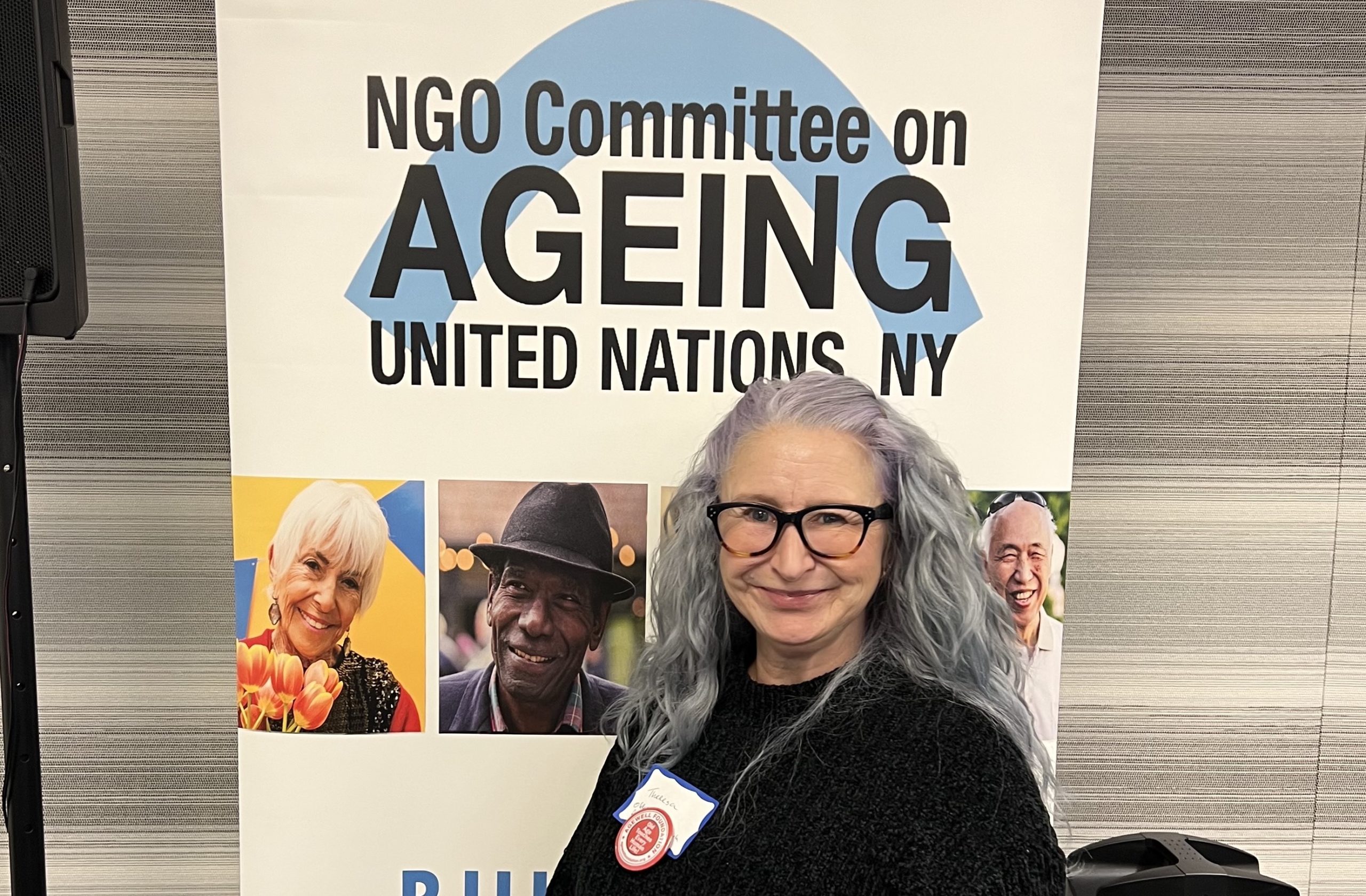
And GAREP had gotten a little grant for some of these satellite organizations around the world to be funded to go and attend the United Nations Open-Ended working group in New York. And OPAN had gave me the opportunity to make an application, which I did, and I was accepted. And what was very, very interesting because I mean there was some amazing people that applied.
I was like, gosh, how did I get in? And it was because I was talking about diversity. I said, we all talk about diversity. There's no [00:52:00] room for cognitive diversity. Why is that? Why is cognitive diversity not good enough to be considered as a diverse attendant? And they took that on board and learned from it that yes, cognitive diversity is legitimate.
And my background of course is superannuation. So I look at cognitive diversity as being a really fundamental component to being on an effective board, for example. And all of that world that I lived in where you had equal representation on industry superfund, boards and the industry superfunds actually perform better because they have this cognitive diversity on the board, which is comprised of people who work in the industry being on the board.
So I'm very confused as to why we don't have cognitive diversity in our other non-government organizations. If it's good [00:53:00] enough for superannuation for our money, but it's not good enough for our people, it seems. Doesn't quite work. Anyway, I did get the opportunity and I rocked up in New York and had the amazing experience of being able to directly address the whole floor.
So you're sitting up in this sort of peanut gallery area with, you know, a little name tag thing like you see on TV and a little microphone and you can see down into the pit where all of those countries are, you know, Luxembourg, this, that and the other. And when I first spoke I said, oh, I'm Theresa Flavin, I'm from Australia.
I live with dementia. And something happened in the room and people actually. Turned in their seats to look up at me had never happened before. It was such a, like a what moment? It really [00:54:00] was very powerful. So I knew I was going to be heard, so I had to make it count and I did my best with that. But I knew I was listened to and I was pointing out that, you know, we're people too.
We don't wake up at the end stage. We have rights, but we're denied our rights because we're still seen as essentially subhuman. And we are, you can tell by the way we're treated that we're are essentially subhuman with a sort of an overlay of hair attached to it. But if we were human, we wouldn't be excluded out of the community as a business as usual would we, but.
Event at the United Nations was the first time in 13 years that we actually got movement. And that's not down to me at whatever. It was just an amazing time to be there when the United Nations went from um, to, yeah, okay, let's take the next step. [00:55:00] And that was amazing. But the most that, that was all fine, you know, people, whatever.
When I left that day and I was just walking back to the hotel with my partner, just walking, and this tiny little old man, him hurrying up to me with his little stick gorgeous little man. And he had been at the United Nations in the public gallery, and this makes me very emotional and he asked if he could hug me because his sister lived with dementia and I spoke for her.
He was so grateful It and the odds of meeting someone in the street of New York who had heard me speak at the United Nations and actually was grateful, was probably the most moving thing I've ever experienced in my life. 'cause he said he'd his parents had been through Holocaust, through different things and he could see that human rights were essentially [00:56:00] gone because you got dementia.
And yeah, that was really, really, really moving that a human being. I actually took some strength from what I was saying and felt heard and that that was amazing.
Catherine: I am not surprised at all by that. Can I ask, is there anywhere to see or hear your speech to the United Nations?
Theresa: I wouldn't have a clue, but I can send you what I said. I could send you the text.
Catherine: Oh my goodness. That I said that would be amazing to actually, yeah, I can
Theresa: absolutely
Catherine: include it in the show notes because yeah.
I'm sure I am going to want to read it and I'm sure there's lots of listeners here that would be very intrigued to actually read your, your presentation to the un. Yeah, that would be amazing. Yeah. Thank you so much.
Theresa: It's be short. It's not a big long read. You only get like 90 seconds or something.
Catherine: be great.
Theresa: Absolutely.
Catherine: And tell me what would you [00:57:00] like to see from the work that you have been instrumental and the change with your partnerships that you've been working with?
You know, the current one that you've got the, with, you know university of New South Wales. What would you like to see be your legacy? From the work that you've been doing?
Theresa: I've never really thought about legacy. That's not really the way my mind sort of goes. If I want, if I was to talk about what change I would like to see, that's very, very urgent.
If you more comfortable with that. Urgent.
Catherine: Yeah.
Theresa: The most important change that needs to be made in Australia is to give people with dementia a pathway, an actual pathway after diagnosis, or even in the prodromal stages where you think you might have it, but you're not formally diagnosed when you know, you know, what that would look like is robust advanced planning tools that are [00:58:00] legally binding.
So at the minute, for example, get your affairs in order, that means your money. Money when you have dementia, money is the least important thing ever. I should not get care less about money I have food and I have shelter, the rest, whatever. But that's where the focus lies. Then you move on to let's make an advance care plan.
So I looked at that and I read the template here in New South Wales and it listed the symptoms of dementia and you could tick a box whether you find them acceptable or unacceptable, like, okay, so they're using dementia as a proxy or whether or not someone would or would not want to live. That's not very good, and there wasn't really any point in completing it because I was gonna get all of these symptoms anyway.
So what was like, I couldn't, I don't have the imagination. [00:59:00] To understand how a person with dementia, the leading cause of death in Australia. People with dementia are being asked to choose. If you don't recognize your loved ones, do you want to, you know, is this palatable or unpalatable? It's clearly unpalatable, but it's also inevitable.
So how's that going to impact your treatment? It makes no sense. There's, it's just strange and confusing. So I thought, okay, well I need more information. I need to make a palliative care plan. You think that would Sounds good. Does that sound very logical? So I tried to make a palliative care plan and I called some organizations and one organization I called, actually I had to provide the phone number of someone who would .
Give the organization assurance that I had the capacity to understand the conversation [01:00:00] starters that they were going to send. So I had to give them a capacity reference. ' cause I had dementia just to get information. I got the information and it was conversation starters. I was like, well what about the content?
What is this shit?
Catherine: Where do you go after that? Well, and, and seeing you were leading the conversation by actually ringing them in the first place.
Theresa: They were very confused. I must have been the first person that ever asked them for information about palliative care. So I got in touch then with a palliative care service that was related to this organization and she sang down the phone in a really nice way that really you know, and a fast care directive may not be the way to.
You might have capacity issues. Let's talk about a plan. What are your values? I was like, what do you mean what, what values? I don't want to talk [01:01:00] about values. I want to talk about end of life medical care. Let's talk about your values first together with your family and let's all talk together and talk it out.
And I'm thinking, my family sitting together at a table about what to do with mom's values is not a good idea.
It's just silly. It stupid. They live all over Australia. They're not gonna come sit around a table. They want to know what I want to do. They want me to tell them what I want and they will do it. Why would they be sitting talking about values like. It just made no sense. know what my values are and I don't need to share them.
I wanted actual information about what death looked like in the context of dementia so that I could actually say yes to this, no to this. So I think maybe because I have complex [01:02:00] PTSD from a whole lot of other things, I do need to know the detail. And it's not so much about control, it's about preparation.
I really need to prepare myself for death. I feel that need really strongly, but that is get kept to such a degree that I actually can't, I can't get the. Facts necessary to be able to prepare myself adequately for death because it's just withheld for, again, paternalistic. It might make me upset, might make someone else upset.
And everything around dementia world is about not making anyone upset. And I'm not scared. You know, the family will have the feelings, I'll be dead. It doesn't matter. But I need to know certain aspects of the death and dying process. 'cause I've watched it with my own family members and I didn't like what I saw.
And [01:03:00] I'll give you an example. I'm trying to find out what palliative care medication might comprise. So I was able to find some stuff on Google that seemed legitimate and it was this thing called a syringe driver. Like, okay, I remember my mother having that. Okay, what's in it? And that was quite hard to, for me to find out what's in it.
'cause I thought, okay, so I can't make a palliative care plan because you're only funded for palliative care for the last three to six months of life. And by then I won't be able to contribute to the plant. So that felt very unfair to say the least. I thought, what's in this thing? And I looked at the ingredients and I thought why would I want that if I'm dying?
You know, sort of sedative sort of stuff. And I thought, well, there must be a good reason. And the further I looked into this, and I'm very happy for any listener to give me better information on this. It all looked about [01:04:00] the dignity of death, dying with dignity. But when I read it from my trauma perspective.
It was down with the appearance of dignity. It was about the dignity of the onlookers and the comfort of the onlookers, not about me. And that made me deeply, deeply troubled about the death process if there's medical intervention. And I still haven't been able to resolve that to any satisfaction.
Catherine: And is that through the voluntary assisted dying process that you'd been
Theresa: looking
Catherine: up? No. Or that
Theresa: it
Catherine: was actually medication that's given?
Theresa: Yep.
Catherine: By palliative Yes. Or doctors in the palliative space?
Theresa: Yeah. Yeah. No. So just
Catherine: to clarify.
Theresa: Yeah, no voluntary assisted dying, because I'll never qualify. I haven't looked into that.
Catherine: Yeah.
Theresa: And I have, I guess my opinions on that are my own. I think everyone has the human right to choose what to do with their body. If you can chill, you know, you can [01:05:00] have an abortion, but you can't abort yourself. Seems very bizarre to me. I know it's a nuanced thing. That's just my very personal thoughts on it.
You know, there's a whole lot of layers of spirituality and things that are personal to me, but at a fundamental level, it seems obscure, paradoxical. I do understand dementia is a different case. What I would say, which isn't much, but what I would say is the state of dementia and age care is so poor that it's not voluntary.
Assisted dying is not a choice in the meaning of active informed choice. An active informed choice means you have two equal options to choose from. In aged care and dementia, you do not. That seems to me like an off ramp and giving people an off ramp because we can't be bothered as a society and community and as country to give people [01:06:00] decent care.
So they're actively choosing whether to live or die. I can't even go towards voluntary assisted dying in the context of dementia because nothing else is on offer. It's just cruel, absolutely cruel and disheartening. But even outside of voluntary assisted dying. Dying is so shrouded in mystery with that overlay of paternalism and dementia.
It's a terminal illness, but we're not supported to process it. And if you think about it from a very logical point of view, and we're thinking about why people behave and express themselves the way they do, we're not supported. We can to process the terminality of our diagnosis in any meaningful way.
You know let's say you have terminal cancer and there's all sorts of, you know, helpful people, you know, talking you through the death and dying process and [01:07:00] how your spirituality and all of that in dementia, you're just hanging. And that it is something that I would absolutely change. So change number one, legacy number one, give people with dementia a proper pathway to help them process and integrate what's coming.
Because if you can't integrate it, how on earth are you going to accept it and process it and live with it. And another thing I would say for the people who. Are actually able to process it and integrate it and accept it. That's called apathy and you're medicated for that. So you can't win.
Catherine: And what would you say to Theresa, to the people who are supporting a loved one who has been diagnosed with dementia, how can they support, in your personal experience, what have you found useful for you? Mm-hmm.
Theresa: Be flexible. We [01:08:00] change, it really helps a few allow us to change and don't keep trying to bring us back to the person we were just to make you feel better or to rescue us.
You can't. And the harder you try, the worse it is for us because we see your pain and we feel your pain. But if you are able to just accept that we are changing. Day by day, week by week, and you change too. So instead of trying to force us to be the same, that you adapt with us, adapt with our flow, even just a little bit.
It helps our nervous system to settle down because we feel safe. If you're always trying to bring us back to function the way you liked it so that you have less pain, that then gives us pain, that feeds your pain and on it goes. And I'm not saying that's easy by any means. I'm not saying it is easy, but it's easier [01:09:00] than not changing.
And I learned that the hard way, that if you don't accept that things are changing and you don't set up your life to accommodate the change and roll with it. And you try to stay static and force , everyone else to change, but not you. That is a recipe for pain for everyone, and that's when people become unsociable and all of that sort of thing.
It, it's a driver for that. It's just one component, just being accepted that we're changing and dying. It's just a slower process than most people expect, I think is the mindset that will help you to also accept and process and integrate what's happening.
Catherine: Theresa, I could keep speaking to you all morning, but I think we, we best say goodbye.
Theresa: Mm-hmm.
Catherine: Is there anything else that you [01:10:00] would like our listeners to, to know? Any, any final thoughts you'd like to
Theresa: make a plan, make a robust plan? If there are no legal mechanisms around that doesn't mean you can't make one write stuff down about what you want and what you need later in dementia when you can't necessarily communicate that.
For example, I'm very, very frightened of going into aged care in a stage of dementia where I can't link my values and my core values to my physical actions. And how that might be expressed is if some charming gent takes me by the hand, I'll happily totter off and have relations with that gent because in my mind, I'll be somewhere in a place that's not able to access the memories and ethics and values and responsibilities and commitments of a lifetime.
There's this thing called terminal and [01:11:00] or paradoxical lucidity, where a person at the very last days of life. Pops back to the original person they were, and it's reports go from 20 to 60% of people get this in terminal illness. My greatest fear is popping back and like the day before I die, only to find my family are all gone because I've broken everyone by doing whatever, by having relations, doing, you know, whatever, unsavory to me, to my mind stuff and I've broken my family.
That's a very deeply personal thing to me. It's not a judgment on anyone else's choices at all. I have no mechanism to project my wishes into the future. The way things stand at the minute in Australia is that people with dementia have a human right to choice and to be supported in that choice. [01:12:00] As a human right to express their sexuality, and that's good.
I support all of that. However, no one's able to take into account actually, which version of me is doing this activity, which version of me is making this choice. It's not the original Theresa, it's Theresa's limbic system. Is that legitimate? Is that consent? Is someone's limbic system consent? I don't think we're anywhere near close enough to understanding why that works.
So what I've done is I have written a behavior support plan for myself, asking people around me, please divert me. Please restrict me from this activity for my dignity and respect the human right of the original Theresa. Now that's not legally binding. I'm trying to support my decisions into the future when I can no longer access me.[01:13:00]
Make a plan, guys, write it down. Whatever it is you need, write it down somewhere so that the people around you have the permission, as it were to keep you safe in the way that you want and need to be safe, not in the way that other people and do greeters and whatever might think you need. And I'm gonna bug out.
Catherine: Theresa, I cannot thank you enough for sharing your valuable insight to what it feels like to be you. Uh, Thank you I can't thank you enough for, for sharing your experiences and for. You actually being the first person to, to speak at the un to to raise the importance of cognitive of diversity.
And, and really sort of showing us that there is a way to move forward in how we look at a future with dementia.
Theresa: Yep. I think we can do better. It's not great, but we can do better. [01:14:00] Absolutely do better, and let's do better.
Catherine: Thanks so much, Theresa.
Theresa: Thank you, Catherine.
We hope you enjoyed today's episode of Don't Be Caught Dead, brought to you by Critical Info. If you liked the episode, learn something new, or were touched by a story you heard, we'd love for you to let us know. Send us an email, even tell your friends, subscribe so you don't miss out on new episodes. If you can spare a few moments.
Please rate and review us as it helps other people to find the show. Are you dying to know more? Stay up to date with. Don't be caught dead by signing up to our newsletter and follow us on social media Head to Don't Be Caught dead.com for more information and loads of resources.