



Finding Purpose in Melbourne’s Forgotten Laneways with Tinky



Listen now
About this episode
When I first discovered Tinky’s tiny installations hidden throughout Melbourne’s laneways, I was instantly captivated. What looked like a whimsical miniature scene often revealed something much deeper: sharp observation, dark humour, storytelling, and a unique way of seeing the world. In this episode, I sit down with Melbourne-based artist Tinky, whose miniature street art has transformed overlooked corners, gutters, walls, and public spaces into unexpected moments of delight and reflection.
Tinky shares the remarkable story of how a spontaneous trip to a vintage market and a toy Big Bird figurine unexpectedly launched an entirely new chapter of her life. From battling imposter syndrome and questioning whether she could even call herself an artist, to exhibiting in galleries, collaborating on major projects, and even catching the attention of Sophie Ellis-Bextor, her journey is a powerful reminder that purpose often arrives in the most unexpected ways.
What unfolds is a conversation about creativity, humour, storytelling, noticing beauty in forgotten places, and how art can help us slow down and see the world differently. We also explore the ephemeral nature of street art, the role of dark humour in processing life, and the joy of creating something that makes complete strangers smile.
Remember; You may not be ready to die, but at least you can be prepared.
Take care,
Catherine
Show notes
Guest Bio
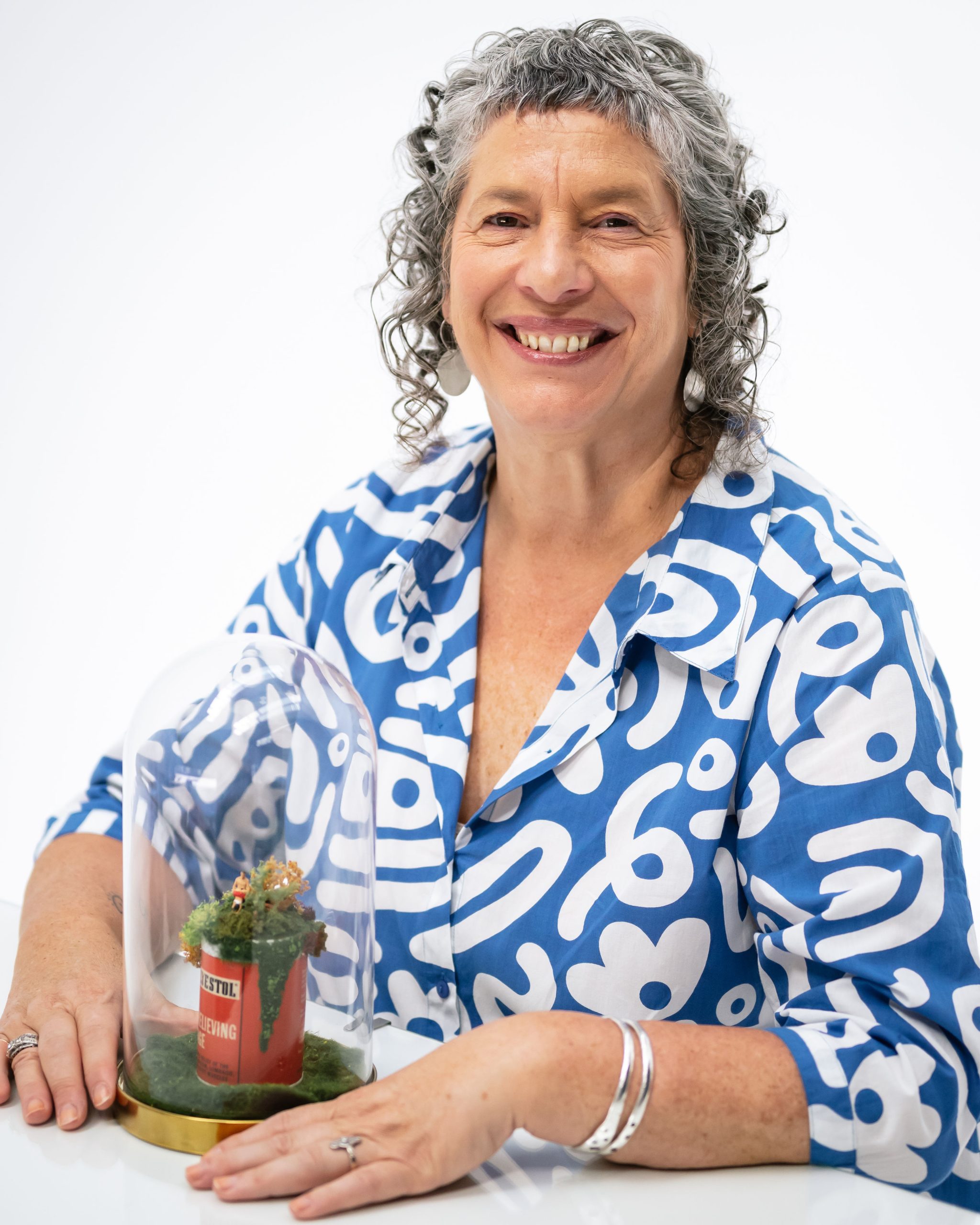
Artist
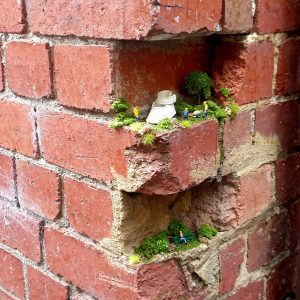
Melbourne-based Australian artist Tinky creates tiny sculptural installations on the street, assembling vintage or found objects with miniature characters and a pun-filled comedic narrative.
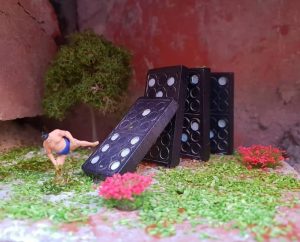
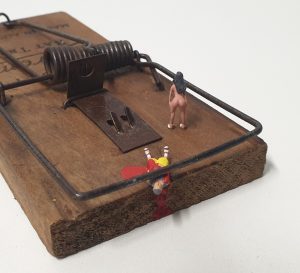
Each element of Tinky’s urban interventions shines a light on the absurdity of an unfolding drama, calamitous undertaking, or playful folly. Faced with a world of mismatched proportions and unexpected scenarios, each miniature character displays a dream-like determination to make the best of their odd situation – aided and abetted by a darkly humorous caption.
Tinky’s installations shift between activating non-spaces – such as a gutter, or a hole-in-the-wall in urban streets and laneways – to curated gallery spaces around the country.
Tinky’s work is featured as part of Harvard University’s Transformative Repair research initiative with Project Zero (2022-2025) and has been featured in the ABC’s three-part TV series, Tiny Oz (2022). Since 2016, Tinky has participated in more than 70 exhibitions, including in regional and metro art galleries, and the Biennale of Australian Art (2018).
Tinky sees her work as an act of forcing the viewer to look at the everyday world and public spaces anew, using comedy as a connector.
Summary
What you’ll hear in this episode:
- How a chance encounter with a toy Big Bird changed the course of Tinky’s life
- Navigating imposter syndrome and learning to embrace the title of artist
- Why humour, storytelling, and miniature worlds have become her creative language
- The beauty of noticing overlooked spaces and finding wonder in the everyday
- How creating art has given her purpose, connection, and a new way of seeing life
Transcript
[00:00:00] Tinky: I'm not an artist. What am I doing here, and what do I do? What am I supposed to do?" Because I'd only ever, mucked around on the streets. I didn't take myself seriously I certainly didn't consider myself an artist for a number of years because I had imposter syndrome I kept thinking, "Oh, someone's gonna find out soon that I'm not meant to be here. Any minute someone's gonna work it out." Catherine: Welcome to Don't Be Caught Dead, a podcast encouraging open conversations about dying and the death of a loved one. I'm your host, Catherine Ashton, founder of Cri ... Read More
[00:00:00]
Tinky: I'm not an artist. What am I doing here, and what do I do? What am I supposed to do?" Because I'd only ever, mucked around on the streets. I didn't take myself seriously I certainly didn't consider myself an artist for a number of years because I had imposter syndrome I kept thinking, "Oh, someone's gonna find out soon that I'm not meant to be here.
Any minute someone's gonna work it out."
Catherine: Welcome to Don't Be Caught Dead, a podcast encouraging open conversations about dying and the death of a loved one. I'm your host, Catherine Ashton, founder of Critical Info, and I'm helping to bring your stories of death back to life because while you may not be ready to die, at least you can be prepared.
Don't be caught dead. Acknowledges the lands of the Kulin nations and recognizes their connection to land, sea, and community. We pay our respects to their elders past, [00:01:00] present, and emerging, and extend that respect to all Aboriginal and Torres Strait Islander and First Nation peoples around the globe.
Catherine: Today I'm speaking with Tinky. Tinky is a Melbourne-based Australian artist that creates tiny sculptural installations on the street, assembling vintage or found objects with miniature characters and a pun-filled comedic narrative.
Each element of Tinky's urban interventions, shines a light on the absurdity of an unfolding drama, calamitous undertaking, or a playful folly. Faced with a world of mismatched proportions and unexpected scenarios, each miniature character displays a dream-like determination to make the best of their odd situation, aided and abetted by a darkly, darkly humorous caption.
Tinky's installations shift between activating [00:02:00] non-spaces, such as a gutter or a hole in the wall in urban streets and laneways, to curated gallery spaces around the country. Tinky's work is featured as part of Harvard University's Transformative Repair research initiative with Project Zero from 2022 to 2025, and has been featured in the ABC's three-part TV series, Tiny Oz, which aired in 2022.
Since 2016, Tinky has participated in more than 70 exhibitions, including in regional and metro art galleries, and the Biennale of Australian Art in 2018. Tinky sees her work as an act of forcing the viewer to look at the everyday world and public spaces anew, using comedy as a connector, and boy, does she do a really good job at it. Thanks so much for being with us, Tinky.
Tinky: Thanks, Catherine. It's, ... I'm so delighted to be on your podcast. Thank you so much for inviting [00:03:00] me.
Catherine: Now, it was a few years ago that I first discovered one of your amazing interventions in a laneway in Melbourne. And ever since then I've been fascinated, so I was very surprised to actually meet you at an art gallery opening in person, and to find out that we're not far away from each other where we're located.
So I'm so excited for you to really sort of give us some insight about how on earth did you get started in this space?
Tinky: Um, It's a funny story, and one I've told on repeat. So I'm, I'm sorry to anyone that might have already heard this, but it's a really unusual step into it about 10 years ago, or 11 years ago now actually.
I s- I was Late to the party in my 40s. And I had discovered street art one day. Literally one day I was walking through the city and I, I d- discovered murals and street art. And it hit me in the face and I was so, blown away by the [00:04:00] beauty of it in sort of gritty laneways and, you know, kind of the, yeah, dirty, dirty sort of laneways where there's, you know, rubbish bins and skip bins and, and then you've got this stunning mural behind, sitting behind it all.
there was so much of that that really blew me away and I, I started following it. I would go into the city and I, I live an hour away from the city, as you know. And I would go in with my husband, Carl. We would just explore the laneways and, and I got to know styles and I got to know specific artists' work.
Like, I could identify who had done it and over time. and so I was photographing it all the time. My, my Instagram feed started off as just an ode to street art in, in Melbourne. and then I was following a lot of street art photographers. There's a whole niche of interesting people in the, street art kind of world.
And, and then I just kind of thought, "Wouldn't it be amazing to be contributing to that in some way? How amazing would [00:05:00] that be?" Not thinking that I would ever do that. And then one day, one Sunday morning I woke up and said to Carl, "Oh, I don't know why, but we have to go to a vintage market and I need to buy vintage toy soldiers and something else, but I don't know what that is yet and I'll know when I see it."
Bless, he just went, "Yep, okay. Let's, let's go." And we went to the Frankston Trash and Treasure when that, existed. And I walked in. I really don't know what it was that kind of it spurred me on to do it. it was just this serendipitous thing where I woke up and it felt quite driven to, to go and find some vintage objects.
And we walked into the market. The second table had, that I saw, had these big jars of old toy soldiers. It was unbelievable. I bought them all, and I was so excited. And then I kept walking around the market, and I didn't know what I was looking for, but I knew I would know when I saw it. And anyway, [00:06:00] I found this little kid's toy.
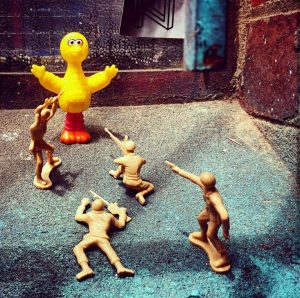
It was a plastic big bird, I think, you know, you get from a fast food outlet that have toys like that sometimes in their Happy Meals. Yeah. And and it was just like a little thing. He was standing with his arms out, and he just looked quite goofy. He had this funny look on his face, and I thought, "Oh my God, that's it.
That's it. That's the thing." $2, bought that. And then I said to Carl, "Now we have to drive to Collingwood, and I wanna find a laneway, and I wanna put it-- I wanna put a little scene together." And so off we went to Collingwood. I found a laneway, I found a windowsill, and I glued the big bird on, and then I had, you know, the toy soldiers around him, holding him up with guns and kind of they were sneaking up.
And I took a photograph of it. I thought it was funny. I really enjoyed the process of all of that. And then that was that for me. I thought, "Oh, well I've done that now. I won't need to do it again." It's just something that I felt driven to do. Took a photo, uploaded it to [00:07:00] Instagram, I think. And then because I was following a lot of street art photographers, unbelievably, someone had found it and photographed it and said on their Instagram, "Does anyone know who did this?"
And so I, I saw it and I was staggered that somebody had found it, 'cause it was only really for my eyes. And I admitted that it was me, and then lots of people were just saying, "Oh, my God, that's funny. You've gotta do more. , Keep doing that. They're really funny." Anyway, and that's how it started.
So I kept playing with little children's toys, I suppose, little plastic figurines, and... So they were never like miniature characters that I work with now. But I didn't really know what I was doing. I was just trying to, you know, I guess make some little joyful moments that people might stumble across and have a laugh and then move on, you know?
So they were just like these little sort of moments of, of comedy, I suppose, for, for me. And oh, God, I loved it so [00:08:00] much. And then it grew. Uh, I think I was doing that for about a year. And then there was a street art studio, or there is a street art studio in Melbourne called Blender Studios, and I'd always really looked up to them, and they had really great artists coming out of that studio.
And Doyle, who runs that studio, sent me a message one day, and I couldn't believe it. I was like, "Why is he messaging me?" And he said, "Hey, we've got a studio available that's got your name on it, if you want." And I messaged him back and said, "Oh, I'm sorry, I think you've sent this to the wrong person."
Catherine: Really?
Tinky: Yeah, because I thought, "Well, he won't be... This is just accidental. There's no way he would be asking me to join Blender Studios" you know? And he's like, "No, no, mate, I haven't sent it to the wrong person. We're offering you a studio." So, I think I cried 'cause I was so excited, and it was just like, "This is unbelievable," you know?
So, I took the studio. [00:09:00] We were paying, you know, rent. It was amazing. It was so fun. There were all of these absolutely insanely creative and wildly fabulous people there that it was just... I- it opened my eyes so much, and so creative and so out there and in your face, and it was just amazing. Brilliant.
Had so much fun at that studio. But the first day I moved in, you know, there's all this kind of excitement and then bringing furniture in and creating your own space to work in. And I remember we'd done, my husband and I had done all that. Carl was sitting there and, and I was sitting at my desk with things, and then I just looked at Carl and said, "What do I do now?"
Like, "I- I'm not an artist. What am I doing here, and what do I do? Like, I don't know what to do. What am I supposed to do?" Because I'd only ever, you know, mucked around on the streets. I didn't take myself seriously one iota. I certainly [00:10:00] didn't consider myself an artist for a number of years because I had imposter syndrome and wondered, I kept thinking, "Oh, someone's gonna find out soon that I'm not meant to be here.
Any minute someone's gonna work it out." And then I, you know, what am I gonna do then? So yeah, it's funny how that... I think it was because I'm not a traditional artist. I can't paint. I don't know how to draw. and I hadn't gone to art school school or, you know, I was just like, "What am I doing here? This is just a joke," you know?
But anyway, I learnt and I p- practiced things and I, you know, I came into my own eventually, but it, it was a really odd feeling to be in, in that space where I didn't feel like I deserved to be. And e- eventually that changed, but it did take quite a while. Did take some years before I thought, "No, I can call myself an artist.
That's okay. I'm allowed."
Catherine: And, and what was it for you in reflection that you thought that after those few years that you thought, "Okay, I can call myself an artist"? Was [00:11:00] there a particular incident or? I
Tinky: think it was just people referring, and my peers who I really respected, referring to me as an artist, but also being very early on, I, I think it was being invited to participate in quite serious art- Exhibitions like the Biennale of Australian Art.
That was a year after I joined Blender Studios. And again, another ... You know, and there was another one, the Benella Street Art Festival. that was all serious artists that I'd respected for a number of years, you know? And so to be in that kind of realm, I still didn't feel like I belonged, but it was very much, well, okay, if I'm getting invited to these things maybe there's something, something to it.
But I think, too, then no one was really, no one was really doing that, I guess. I mean, there, there were probably ... Just trying to think now. There were probably, there was an artist who'd done something [00:12:00] with miniatures that I think probably s- people thought I'd copied, but I hadn't at all. It was j- What I was doing was just coming from my own head.
Yeah, I don't know. I think it was just being involved in some projects and, and things like that, that kind of elevated maybe my small standing in that scene a little bit, that I felt a little bit more accepted or something. I, you know, it's funny. I still sometimes feel it that, you know, do people think I'm a bit of a fake?
Because I've come in, you know, without that proper educa- uh, art education. But it's okay. I, I ma- I, I make people laugh, and that, that's the main thing, you know, I think. I think when people were laughing at some of the artworks and the puns and the, the stories and, you know, I think, well, it's... I'm doing something in the space, so it's gotta be, gotta be right.
Catherine: And tell me you know, Blender are an organization that, you know, you were talking about how you hadn't gone to art [00:13:00] school. You- Mm ... you had that imposter syndrome.
Tinky: Mm.
Catherine: But the space of street art is very different to any of those normal conventions and those normal pathways. And I think, you know, having myself been on, a couple of street art tours with- Mm
with Blender Studios and- Right ... and the amazing artists that, that they have that operate out of there- Yeah ... you get an insight into art as a different way of looking at it, you know? Right. It's, it's a very different way of how they interpret the world and how they- Yeah ... also see it, and then through a totally different medium, and also the ephemeral nature of what street art is as well.
Tinky: Yeah, that's right.
Catherine: So when you think of your, your own work and your, you know, take it, take you back to that, that moment when you're sitting at your desk and you say to Carl, "What am I supposed to do now?"
Tinky: Yeah. It was like a revelation of I've done all...
I've moved in, but I, I, I legitimately did not know what I [00:14:00] was supposed to do. And so how
Catherine: did you start?
Tinky: And there were artists everywhere. Gosh, I think I had some vintage, little vintage. So I'm also a bit of a collector. I love vintage things, and I've always, you know, I used to be a I used to have my second-hand art dealer's license.
Not se- no, second-hand dealer's license when I was in my 20s. So I've always done your garage sales and markets, so I've, I've always had that kind of interest in old things and vintage things. So I'd probably had amassed a little bit of a collection of things anyway, and then started thinking about how I c- could incorporate that with small, you know, little toys.
And then it kind of, yeah, I, I don't know how. I actually can't remember the, the first thing I did. I can't really remember it. But I did discover, you know, like, little miniature figurines that I, that I, I don't make myself. I, you know, I buy those, and then just sort of [00:15:00] assemble them with vintage object and create a scene with all of that.
So I imagine I would have already had those and just started playing around. Yeah, I think, like, it's ve- very much morphed into something that it never was initially. Like, you know, it was just something that's grown over a number of years, I think. Or the first five years are probably really just kept changing my style a little bit and, and playing around, and then finding ways of, you know, making trees or making bases for the scene to be on, and yeah.
And then starting to do things for galleries, and that, that took that away from just the street stuff. The street stuff was great because, and is great because you can just kind of go in, you have all your stuff. You find just your hole in the wall or your gutter or your windowsill or whatever it is, and you can just sneakily work away.
I look really weird though from the other side of things because it looks like I'm a middle-aged woman [00:16:00] staring at a wall in, in a laneway. It looks so dodgy and, and stupid. But then I think when I walk away from that and I've done my scene and people, I know people can accidentally find it, that, that's the best feeling.
Yeah, so the gallery stuff then took me out of the street stuff a little bit. I was still, I can still do both. But then when I was starting to go into galleries, that made me feel more sort of an artist because I figured, well, galleries won't have me in there if I'm not, you know, producing something that they think is art.
So yeah, that helped as well
Catherine: And tell me, through this sort of evolution of, of how you've developed o- through those years, when was it, you know, that you started getting that, that feedback? Like you had that first feedback where someone found your, your Big Bird and your toy soldiers, and that was your first bit, bit of feedback.
But tell me about how you were interacting. 'Cause like you said, you, you, you kind of are there for that [00:17:00] moment, especially- Mm ... in the, the alleyways and, and wherever your, your secret location is. And then you, you walk away, and then there is- Mm ... no follow-up. Like you're, you're removed from there then. So how did you know that you were having that, that impact?
Tinky: I guess I didn't know really until you know, I started to get... Well, yeah, it's funny 'cause I never put my name to anything.
Catherine: Yeah.
Tinky: So To be honest, I don't know how people found me. I think some of it was through the skills of other street art photographers who are really passionate about street art and love to capture the magic around the laneways.
And, and I probably m- maybe people heard just from, from their images and their chatting about it. And I think I was very fortunate very early on to have some media attention. I think the first story was with The Age in Melbourne. And so that, that sort of garnered a bit of attention.
And then [00:18:00] from that article, there were some other things that were happening from other media outlets, and a couple of festivals I was involved with that had TV. So then that... And then TV reports and things. So then, yeah, word got out a little bit. And then I thought, "Well, I have to have a name." Like a, a street art name obviously, 'cause everyone does.
And then came u- Yeah, well, I just used a nickname I had as a child that my parents had given me, Tinky.
Catherine: gonna have to ask. Yeah. What was the origin of the, of
Tinky: the nickname? Oh, it's so daggy. It's just such a non-exciting way. But I used to be obsessed with Tinkerbell, and I had a little, little T-shirt that I wore constantly that had a Tinkerbell on it and a wand.
And sh- and there was a real diamond attached to the T-shirt. Oh,
Catherine: that's so cool. That
Tinky: I thought was a real diamond and, you know. And so I was just obsessed. Anyway, so that's how Tinky came about, and then my family called me Tinky. And childhood- I love that ... but we got stuck with it 'cause it's kind of, you know, It was kinda cute and not [00:19:00] serious, the name, you know?
And I didn't, yeah, I didn't wanna be, like, the serious artist. I liked the idea of it was just a bit fun and whimsical, I suppose. So it ki- felt like it matched up, so I just kept going. Yeah. So I was lucky anyways to have a bit of media, and I think that kind of- Yeah, I think word got out a little bit through that.
Yeah
Catherine: And, and where does the sense of humor... Like, they are hilarious, your, some of your- Oh, thanks ... you know, artworks. They have a really, you know, sometimes dark, but a really good sense of humor.
Tinky: Thanks, Catherine. I, I, take that as the highest compliment, 'cause I I was fairly funny as a kid, and I w- you know, I wasn't the smartest kid.
I wasn't, you know, a good-looking kid. I wasn't like any of those things, but I was funny. And I think that's, you know, where the humor comes from. I was also very, very obsessed with [00:20:00] that American cartoonist by the name of Gary Larson who was-
Catherine: The Far Side
Tinky: Yes, The Far Side. And I didn't make this connection until years and years into my, uh- That makes
Catherine: total sense
Tinky: I was obsessed with him and his cartoons throughout the '80s. My cousin and I were just obsessed and, you know, and we still buy greeting cards that have got Far Side cartoons on them, 'cause they're so hilarious. And I didn't c- make the connection, but I think I loved that, like, it- it's just an image of something that is so ridiculous, and then a one-liner that's just, you know, like, that third person telling what's happened in that image.
Yeah, and I just used to love it. And I, I- I mean, I'm absolutely certain he's been an in- massive inspiration for me without even realizing. Yeah. took me probably only a couple of years ago to, to work that out. You know, a bit slow on the [00:21:00] uptake, but there we go.
Catherine: Well, you know, you don't ever...
Very, very rarely in life do you ever reflect on why we act or we do what we do until you have a moment where you go- Mm ... or, and, and because you've obviously done a lot of media and had to tell your story. Like, it probably wasn't until then that you had that opportunity to reflect.
Tinky: Really, that's so true, 'cause I haven't reflected.
I've just gone along. And the other funny thing about that is I just assumed everyone thought like that. I didn't realize that it was unusual. I honestly thought... Because I th- I often look at things or experience things or think about things from a funny, like from a comedic lens., , My mind goes to humor in every circumstance.
Almost. and often very inappropriate times, you know? But I just, it's just where my mind goes, and I love to make people laugh. I really do. It gives me the, it gives me quite a thrill if I've made someone laugh, you know, [00:22:00] even through a conversation or g- you know, whatever. Sharing a story or whatever.
Yeah, so I think it's just where my mind goes. And then I think I said to somebody once, you know, "Does, but, but don't you think like that? Doesn't everyone think like that?" And they w- looked at me and went, "No. No, they don't." So
Catherine: that was
Tinky: fun. I,
Catherine: I f- I, I love the fact that you know, for you, life is a series of, of Gary Larson cartoons and skits.
Like, that is a great way. But you know, I, I know that Tinky is, is one side of, of who you are as a person. How has this ability to see life through that lens in a unique way, how has that allowed you to cope when things aren't that great?
Tinky: Well, that's a really good question.
Look, for me, I have to say I'm very lucky in my life. Things are mostly great. When they haven't been, I'm the first person to admit I really do not deal with stress well at [00:23:00] all. Never have. And, you know, as much as I try, I, well, I don't know if, if I can. It, we are who we are, right? So I don't know how I do it.
I'm not even sure that I lean into the artwork if I'm in a period of massive stress. I think it, what I like about it is that you can get really lost in it, and I think then maybe that takes you away from thinking about anything that's really troubling you at the time. So you can escape in it, you know?
In that little world and focus on that rather than focusing on the big thing that's eating away at you. But I, I really do have to say I have, I've been very fortunate that I haven't had any massive trauma in my life, which at 58 is really quite incredible, you know, I think. I've been very lucky. I don't know anyone that hasn't experienced some form of big [00:24:00] trauma in their life at this age.
Yeah. So I don't know. It's quite joyful, you know, to do and so it does make me happy. And also, you know, I'm embarrassed to say sometimes I laugh at my own jokes and then, and then I think, "Oh, okay, if I've laughed at it, then hopefully other, other people will find it funny." Yeah
Catherine: And tell me, you talked about the evolution of your artwork, how you were buying vintage items and, and then you mentioned how you now have a focus with the actual little figurines that you
the small- Yep ... little fig- miniatures that you, you use. with that, that evolution in your artwork process what have you found that about yourself during that time and that, that, that sort of change?
Tinky: Mm-hmm. I've found that I've got a very dark sense of humor, very dark. Which obviously comes out in my artworks [00:25:00] because, and this is going to sound terribly inappropriate, but it just is what it is.
I think things like death, dying, murder you know, gore, they're not funny things in themselves. They're just, they're so far removed from funny in real life. But in miniature, and where you can set up a scene where someone's tripped over and killed themselves, or something's crashed down on them and split their head open, or I don't know.
Sorry if this is too much. Should probably uh, said I had a trigger warning. But when it's in miniature form and there's something kind of calamitous about what that little miniature figurine has done to get to this ridiculous scenario where they've broken their leg or something, it's a bit like the Darwin Awards.
you know, dumb ways to die, that kind of thing. in a tiny scale, there it lends itself to being funny, as opposed to in real life obviously. They're [00:26:00] poles apart. So yeah, I've learnt that I have a dark sense of humor and that that really, I don't know where that's come from.
I don't know where the darkness of it has come from. But I don't see it as morbid. I don't go into it thinking, " Oh, let's do a murder scene." It's like I actually look at the vintage object first usually, and go, "Oh, now how can this interact with a miniature where they've done something stupid?" You know.
Like there's, you know, I'm staring at one now that's a circus scene. And- I don't know. I can hold it up, but I don't know if you can see it.
Catherine: Yeah. What we can do is we can even include a, a an image of it on the show notes, and i- it'd be great for you to describe your own artwork in this image, and people who are on YouTube- Yeah
can actually view the, the video itself. But I'm looking at a, a big top. and there is definitely a figure lying on the ground.
Tinky: Yes. Now-
Catherine: Can you explain that?
Tinky: I'll [00:27:00] explain that. So this is a little vintage plastic children's toy, the big top-
Catherine: Yeah ...
Tinky: that I found at Camberwell Market. Around it and i- inside it are a family enjoying a s- a circus scene.
There's like a pony in there. There's the tall, the man on stilts. There's a bear on a, on a... you know, balancing on a ball. There's the sword swallower. And very sadly, there's a deceased person on a white sheet at, in front of the big top that has been cut in half. So it's very... The scene is very bloody.
There's a lot of blood. She's literally cut in half, Basically the, the you know, the, the, the pe- people... Oh, what, what are they called? The man that cuts w- women in half on the, in the circus, you know, and they kind of split- The
Catherine: magician ...
Tinky: That. Magician. That's the word.
Catherine: Yeah.
It's
Tinky: this meno brain that I forget words. Um, Yeah, so there's been obviously some [00:28:00] terrible accident where the real blade was used rather than the fake m- magic one. And so I mean, that sounds very dark. If you can't see the scene, that sounds terrible. But it's kind of... To me it's, looks funny because everyone's enjoying the circus, and people are laughing and smiling, but there's this terrible kind of situation that's happened with the death of someone as a result of, you know, the wrong blade being used.
So- Yeah, I don't know. I just saw that big top and thought, "Oh, I could do so much with, with that."
Catherine: And, and you're right. Like, to look at them, they look rather, you know, like a, like a little diorama that you would normally see. Yeah You know? That we, we see with, you know, trains and those sorts of things.
They're a perfect little miniature diorama, but then they have that other element of humor to it.
Tinky: That's right. Very dark humor. And this one I'll, I'll just, ... I'll see if you can see this one as well. But it's a vintage nutcracker, and it's [00:29:00] a hilarious shape of nutcracker. And there's a walnut under there and, and a little man that has been crushed by the, the nutcracker accidentally, and there's some people that are trying to get him off the, the nut.
Um-
Catherine: That is really, really an OHNS risk, isn't it? Oh, sure. Like- Yeah ... and it is, it's a very, very dramatic nutcracker. I've never seen anything like it. It looks like more like a- No ... industrial vice. So we will definitely, we will definitely share photos of these on the show notes and- Right ... and you'll be able to see it on the video.
But-
Tinky: Mm ...
Catherine: tell me, or, or let's tell the audience about your most famous moment where if you don't mind sharing- Yeah ... about your Murder on the Dance Floor.
Tinky: Well, yes. Okay. This was, this was unbelievable to me. So I had been commissioned to do an artwork, a Murder on the Dance Floor artwork. I'd done one before in an exhibition and it had sold and somebody contacted me and said, "I really want one.
Can you make me one?" And it was [00:30:00] essentially a sort of disco dance floor with a little miniature you know, disco ball that you, you know, the little foam ones covered in mirrors. Mirror ball. So all small in a glass cloche. And- Yeah, so I've done, I've done the, the scene with the ball, and the ball has fallen from, from the ceiling and, and crushed one of
somebody who was dancing. And there's, you know, blood and stuff happening as well, and people all surrounding going, "What? Oh my God, there's been a murder on the dance floor." And as I usually do, I, I, I made the artwork, I gave it to the owner and posted it on Instagram with the Murder on the Dancefloor song playing in the background.
Just a normal post for me, like nothing, didn't think anything more of it. The following day I'm checking my Instagram and I can see Sophie Ellis-Bextor has liked your post, and I [00:31:00] nearly died. I, in fact, I screamed so loudly. I was sitting next to Carl, and he got annoyed at me because I'd screamed in his ear, and he was kind of like, "Oh, what are you screaming for?"
You know? And I said, "Sophie Ellis-Bextor's, you know, liked my post. Oh my God." You know, who, who of course she wrote and sang Murder on the Dancefloor. Very well-known British pop star, and I was just like, "This is incredible." And then she d- DM'd me and said, "Oh, I really love what you do." So we were having a chat, but I didn't, I didn't want to fan girl 'cause I didn't want to scare her off, and I didn't wanna cont- keep continuing a chat 'cause I thought, "Oh, she's just gonna think now I'm gonna stalk her."
So in a way, I kind of, ... You know, we chatted for a tiny bit and I said, "Thank," you know, "Thank you so much. It's so lovely." And I just, you know, love heart and just left it. I didn't kind of bang on about anything. And then she responded and she said, "No, no. I really do love what you do. This is, you know, great and, you know, I love miniatures," and dah, [00:32:00] dah, dah, dah.
And you know, probably thanked her again and, and then just let it go. I, I just didn't continue 'cause I thought, "Oh, she's gonna ... I don't wanna annoy her. She probably gets, you know, people kind of wanting to talk to her and stuff." So anyway and that was just, like, the highlight of my life. I was just like, "This is just incredible."
Anyway. Two weeks later, the person that bought my artwork, that artwork, messaged me and said, "Did you know Sophie Ellis-Bextor is coming to Melbourne next week to sing at-" the Melbourne Art Gallery or s- I don't know, something, for a very unique, small bunch of people. It was some event, I can't remember what it was.
And I was like, "Oh my God." And she said, "You need to reach out to her. You need to," you know. And I thought, "How can I possibly do that?" You know. Anyway, I did. I contacted her and I said, you know, "Look, I've just learnt you're coming to Melbourne. I'd really love to gift you an artwork, only if you'd like it.
You, you don't have, don't feel obliged to say yes. I'm [00:33:00] happy to just drop it with your manager." Like, I was trying to make it so that I, I wasn't trying to say to her, you know, I wanna, you know, meet her. Of course, I wanted to meet her. But I was just kind of saying, "No, I'll give it to your manager.
I'm happy to drop it somewhere for you." You know. And she was like, "No, that'd be great, thank you. Here's my phone number." She gave me her mobile number and she said, "Contact me a couple of days before I get there, and we'll work out a time to meet up." And I was like, "Oh my God, she doesn't have a manager with her or anything."
Like, you know. So anyway, I did. I get to, I got to meet her. We had a drink together. We had the best conversation, just so natural. Really got along well, and she was just gorgeous. And yeah. So I'm hoping she got... who knows if she's kept it or got it in her house or got it home. You know, they're awkward to travel with, so, yeah.
But that was, that was lovely. Lovely experience.
Catherine: That's a, that's a [00:34:00] long way from the woman sitting in the gallery not knowing what she was gonna do next.
Tinky: It's crazy. Absolutely a long way. Yeah, I know. I don't know where I got that confidence from, but anyway, yeah. I'm glad, I'm glad she, I'm glad sh- you know, it was lovely to meet her and hand her the artwork and, but m- more than anything, we had just lovely conversation. It was very, felt very real and genuine, not forced or... Yeah, she was lovely, and beautiful. My God, that woman is stunning.
Catherine: what do you think draws you to the items that are vintage, that have already had one life and, and now you give them another? Like, what do you think has- ... has allowed you to collect those pieces over time? What attracts you to it?
Tinky: to be honest, for the last probably 10 years or so, I'm attracted to certain items because of their humorous nature. The, like, I, I know instantly if I can do something humorous with [00:35:00] something. And so, and I just know my brain will go, "Oh, I know I can do something funny with that."
So usually I do li- have to like the item, but sometimes I just know that I can do something really funny with it, and so that will be the impetus for me to want to collect it. Yeah. I look, you know, I've had phases with, you know, wanting to collect certain things, and then five years later I've gone off that and got rid of them, and then I'm onto the next, you know, the next type of vintage item.
But yeah, I don't know. S- and sometimes I'll have, I'll f- I'll have a miniature that I just know would be really funny in a particular scene if I had a particular vintage item, and then I can go actually hunting for that particular vintage item. It's hard to explain. Does that make sense? So sometimes I'm
I can get inspiration either from the miniature character or from the vintage item that I just stumble across in a junk store or antique shop or something.
Catherine: And is in that when you, [00:36:00] you think of sort of like the pun or the, the catchphrase? So it's, it's the item that drives the-
Tinky: It's the item.
Yeah. And, and normally what I know I can do, I can no- normally think of the scene very quickly. The pun takes a bit of work. Usually ... It doesn't take a bit of work. I usually do the pun after, sometimes before, but usually after, and that is just by ... God, I've never used a thesaurus so many times in my life.
But usually it's like kind of coming up with lots of different words that are connected to this item. You know, like with the circus one, you know, there's tent. Oh you know, magician or, ... Oh, look, I, now I can't think of the words. But usually I will just find lots of words that will describe that thing, and then hopefully I can use one of those words in a double entendre way or you know, I can twist it so that it's a bit more of a dad joke, a pun [00:37:00] in some way.
Yeah. So it has a double meaning. Like that that nutcracker I just showed you, the, the brand is called Bonk, B-O-N-K. It's like, "Oh, that's gold."
Catherine: That just, that just lends itself to being in- It's just so much ... in a little diorama, doesn't it? It
Tinky: really does. Yeah. Yeah. And there's one I have just using like a
It's a real microscope, but it's a very small microscope that's come from Melbourne University, I think, from the, in the olden days. And I've got the little glass slides and, you know, there's been a murder on the glass slide, and there's policemen on the slide and, you know, there's a little miniature magnifying glass that's come out of some vintage medical equipment.
And, you know, like assembling all that together and then having a, a murder scene on a slide, and then being able to use words around that- That can be kind of made into a pun. Like, that's the fun part, is coming up with the, the [00:38:00] narrative, the little story,
Catherine: and I have to say, I really must encourage everyone to check out your Instagram if they're on Insta.
Oh, thank you. Because it really is such a relief in the day to actually see what you've been up to.
Tinky: Oh, thank you.
Catherine: And, and what spaces you've been working at, or what particular artwork. Because it, it really is quite hilarious the little-- the captions that you provide and the stories that you, you give.
Tinky: Yeah, thanks.
Catherine: What has this sort of developing this side of who you are and really going a deep dive on, developing your art practice- Mm ... what has that told you about who you are as a person, and how you value things in life?
Tinky: Oh. Well, I have to say, one obvious thing for me is that I've really learnt to stop and really take [00:39:00] in the environment around me.
So whether that's in a dirty laneway. Like, I can walk into a dirty laneway in Melbourne that most people would avoid for whatever reason, 'cause it stinks and it's dirty and, you know, maybe there's some nefarious behavior that's, that's gone on in there or whatever. But I can look at really old-- a really old brick wall and know that that's, like, maybe a historic building.
What's gone on in that building? What's gone on? Have there been horses that have been down this laneway at some point? Or then I can look at, you know, maybe an, some old signwrit- writing on a wall that's been there forever, and I just think, "That's beautiful," the old fonts that used to be used. Or an old paste up that's kind of gone all gnarly and, and kind of broken down over the bricks.
It makes me, like, really notice small things like that, that we would otherwise just walk past, not notice, or think it's a bit, you [00:40:00] know, rubbishy or whatever. But mostly that we don't notice. and finding the little holes in the wall or a crack or something like that where you can create a whole other world in this tiny space it really...
Now I can't walk anywhere without looking for a gap in a brick or, you know. I, I love walking in places that people wouldn't ordinarily, you know, go to, Yeah. And Carl and I just recently came back from a trip to China and I took, I took something with me that I could do on the Great Wall. And now not, not with gluing.
I didn't wanna obviously be in- disrespectful in any way, in that way. So I managed to do it without using any glue, of course. But it was just a way of having-- like using the environment that you've got and using the background and the backdrop and the, you know, being on this amazing Great Wall of China, and it's just incredible.
And then adding a silly [00:41:00] little thing to that that's still related to a wall and bricks and, You know, yeah, it just makes me see things completely differently. And I hope, too, that when people spot my little scenes , in the streets, I hope that it does that for them, too. Like, that it makes people slow down, go, "Oh, if I'd, you know, if I'd rushed past that, I would've missed that little bit of joy in that wall."
And so hopefully it encourages people just to slow down and kind of really appreciate the environment around us. Yeah. So that, I guess that's for me what it's done. It's made me focus on the little, little things that can be beautiful even though something might be broken or cracked or missing.
Yeah, you can still find a lot of beauty in spaces. Yeah.
Catherine: And how does it sit with you, the ephemeral nature of your artworks- Mm ... that are actually out in the world [00:42:00] there?
Tinky: If I'm being really honest, like I used to say, "Oh, you know, once I put it there and walk away, it's not mine anymore." And you know, I... And, and it's true.
Once I've, - I put something in a s- in a space I don't own, so it, I don't have any ownership over the brick wall or the gutter or it's not my space. I've borrowed it and I've put a little scene there. And I do, you know, I photograph it and I do walk away and go, "Okay, great. That's fulfilled something for me in a creative way, and I've had a laugh.
And hopefully someone else sees it." But if I'm being really honest, if, if it hasn't lasted longer than an hour and someone's come along and destroyed it or tried to steal it to take home, and then broken the pieces 'cause they don't realize it's s- glued down with industrial strength glue and and then it's all ruined, part of me does go, "Oh, damn it."
'Cause it... But just from the point, not from the point of view of that's my artwork, more from the point of view [00:43:00] of, oh, no one else gets to enjoy it now. Yeah. So I'll be, you know, I'd, I'd be lying if I said it, I mean, it doesn't bother me. Like, I don't lose sleep over it. But part of me is like, "Oh, now no one else gets to see it."
Yeah. But then I guess, you know, I take a photo and it is what it is. It is ephemeral and . sometimes they can last and the weather just wears them away, and that's lovely. I had one artwork that lasted five years- Wow ... in, in a really big, long space. But, but it was situated not at eye level, so it, people would often walk past and...
Well, not often, it was probably a bit hidden away. but yeah, then I've had things that last, you know, an hour. yeah, that's what it is. It's the same with, you know, murals or, you know, you can- things can be tagged over or painted over really quickly as well. It's just what it is. Yeah. And it's, you're borrowing, you're borrowing space really, aren't you?
You know. it's much easier for me because no one [00:44:00] gets terribly offended if I'm borrowing a tiny space, whereas a, you know, a mural artist or, or a tagger or someone that's just taken over a wall, I mean, they can go to jail for that. They can be arrested for that. Whereas I, I don't have to worry about things like that.
So that's, well, it's ephemeral for them and for me, but I, yeah, I don't have to worry about like a negative- Result for me personally. Yeah.
Catherine: And do you have a favorite?
Tinky: Oh. Look, I have to say the one that has the least artistic merit, which is the very first one with the big bird. It has to be.
I, because it's, it changed my life , doing that. That - completely changed my life. But yes, I do have a favorite. It's a, it was a, an old s- I don't know, it was some kind of security camera, really big. One that you'd see on the street, on the road, like [00:45:00] quite, quite long, about that long.
And and the guts of it was all t- taken out, but it still had a circle that obviously where the, the flash, where the light and camera part was, the recording device. And you could just open it up from the top. It, literally the whole roof of it just opened up, and then there was this empty space. And actually Carl found that in an antique shop, and it was the best thing I ever, well, he ever found, we ever found.
And I did a s- a scene in there. It was a murder scene, but I used the whole space. And so, I had a, a friend that was able to help me and Carl put some little electronic devices in there. So there was a blue light and a red light, and they were just flashing. So when you... When it was finished and you closed up and you had the security camera as it would always, you know, appear and it, there'd just be these subtle red and blue lights in there that, that were, you know, kind of meant to indicate that there was [00:46:00] a police unit there.
A car, you know, a car and police officers, and there was a murder scene in a park. Again, not funny if it was in real life, but in, in this... You know, when it was inside a, a camera, a recording camera sorry, a security camera, it just seemed... It just looked gorgeous, and then the lights, you know. And, and it was so subtle, and it was part of it was part of a, a big arts festival in Kensington just the week before COVID hit in M- in Melbourne when we were in lockdown.
And so it had a lot of eyes on it, but only... It was really funny, like you had to really, really look at it because it looked like a normal security camera. But it wasn't until you got up close underneath it that you could see it flashing and the, the, and you could see the murder scene. So that was probably my favorite one that I've ever done.
Yeah. Yeah, I loved that.
Catherine: And when you say that Big Bird and the toy soldiers changed your life-
Tinky: well, it was, it kind of ... Because it [00:47:00] launched me into this whole other creative part of my life, I ... It gave me a purpose. So it actually gave me purpose and it opened up my world to a whole band of people I would otherwise have never have met, and have never been exposed to how creative minds work.
'Cause I never ... I mean, I was ... I'd always had a creative mind. Like, I, you know, made jewelry for years and sold jewelry and, and you know, like I've al- and I've ... And ex-journo, so I've, I've always been, you know, like I've, I write and, and m- you know, I like storytelling basically. So I've always had that in me.
But I think with this, it's, it's completely different because it's a very public platform and- yeah, it just, it, it just gave me opportunities I, I would never have otherwise had. [00:48:00] and I've met, you know, incredible collectors, art collectors, and met beautiful people on the street that just wanna talk about what I'm doing.
And, you know, it's just given me exposure to all these l- like, truly incredible experiences that I'm so grateful for. That, you know, if I hadn't done that Big Bird. If I shouldn't have met Big Bird that day it would never have happened. So... Well, I don't think it would've anyway.
I can't imagine how else it would've come about. So yeah, it's just given me great opportunities and, you know, like, the TV show, Tiny Oz with Jimmy Rees. I mean, that, you know, things like that have come out an- have given me, like, really great life experience. And the Harvard University project with Kerry Grammar, you know, that like, who would've ever thought that, like, something like that would've happened?
I was just living my life normally, you know? Just going to work and having a home life and socializing with friends. There was nothing [00:49:00] else really huge that was going on until this happened. Yeah. Yeah. And made a whole bunch of new, you know, well, not new now, but, like, friends that, that are all creatives and really fun and interesting people.
Yeah. So it's just enhanced my life so much.
Catherine: But it's also enhanced ours too. Don't worry about that, Tinky. Like- So much ... yeah, the way in which you view life and have been able to show that to others is amazing. I'm very happy that you found Big Bird that day.
Tinky: Thank you so much. Me too.
Catherine: Thank you so much for sharing your story with us today.
Tinky: Thank you, Catherine.
Catherine: We hope you enjoyed today's episode of Don't Be Caught Dead, brought to you by Critical Info. If you liked the episode, learn something new, or were touched by a story you heard, we'd love for you to let us know. Send us an email, even tell your friends, [00:50:00] subscribe so you don't miss out on new episodes. If you can spare a few moments.
Please rate and review us as it helps other people to find the show. Are you dying to know more? Stay up to date with. Don't be caught dead by signing up to our newsletter and follow us on social media Head to Don't Be Caught dead.com for more information and loads of resources.
Read Less
Resources
Connect With Tinky
Instagram: https://www.instagram.com/tinkysonntag
Connect with Critical Info
- Make Death Admin Easy with The Critical Info Platform
A simple system to sort your personal paperwork for when your information becomes critical.
- My Loved One Has Died, What Do I Do Now?
Our guide, ‘My Loved One Has Died, What Do I Do Now?’ provides practical steps for the hours and days after a loved one's death. Purchase it here.
- Support Services
If you're feeling overwhelmed by grief, find support through our resources and bereavement services here.
- Support the 'Don’t Be Caught Dead' podcast with a one-off or regular donation to help Critical Info, a certified social enterprise, keep creating free, high-impact conversations about death, grief and planning—every contribution fuels our mission to reduce the burden on families and build a more death-literate, compassionate community. Donate now.


Share